
Pretty simple guys. Stocks always go up, and even when they don’t they do.
Dave Portnoy, aka Davey Day Trader Global
These days, if you need to be entertained and have a good laugh, all you need to do is get on Twitter and see Davey Day Trader go up against the stock market “experts” and observe the back-and-forth banter. For those of you unfamiliar with Davey, he is Dave Portnoy, the president of Barstool Sports, who in the past spent a lot of his time focused on sports gambling. With no sports to bet on the past few months, and with a new load of cash on hand with the sale of 36% of his business to Penn National Gaming, Davey took up day trading to get his daily gambling fix. If crude language doesn’t bother you, then Davey is a good place to go to get entertained, especially if you follow the stock market.

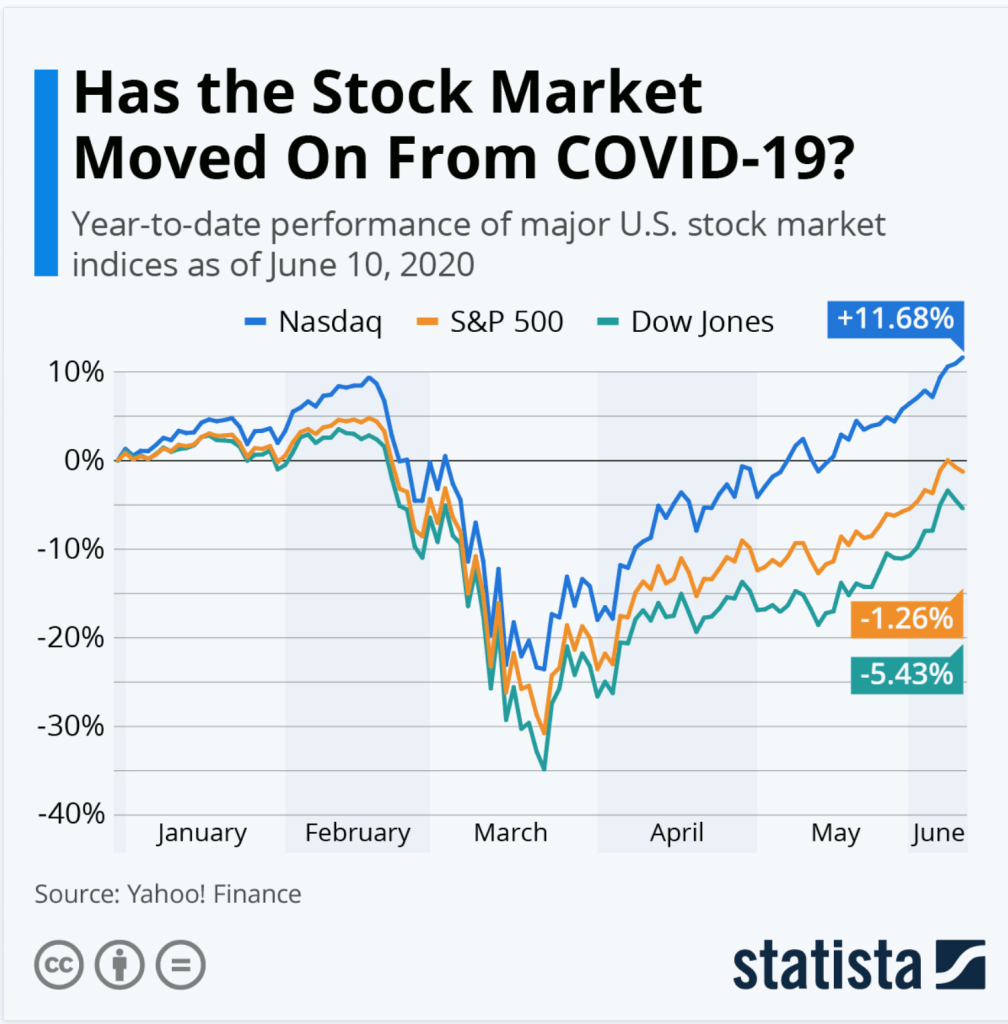
The biggest debate in the financial world today is the age old question of whether the stock market will keep going up, or will we have a repeat of the late February downturn that will ruin the portfolio of Davey Day Trader and his legion of followers. As you know, I follow the markets and the economy closely, and I would put my money on us being in a Bull Trap rather than the start of a new Bull Market.
Bull Market – A bull market is a financial market of a group of securities in which prices are rising or are expected to rise.
Bull Trap – A bull trap is a temporary reversal in an otherwise bear market that lures in long investors who then experience deeper losses.
Investopedia
The key argument that we are in the beginning of a new bull market is driven by the belief that the flood of liquidity coming from central banks is finding its way into the financial markets and will continue to drive increases in stock prices and valuations. And there is merit to this argument, as in recent years there is a strong correlation between central bank-driven liquidity and stock prices. Another argument for a bull market is driven by the belief that the economy will quickly recover from the pandemic-driven shutdown, i.e. experiencing a “V-shaped” recovery.
The key argument that we are in a bull trap is centered on the belief that, over time, stock prices will reflect the strength or weakness of the underlying business conditions, reflected in the increase or decrease in corporate profits. The pandemic has pushed the world economy into a deep recession, and so far the stock market has not taken the drop in GDP into account in stock valuations. Those of us who believe we are in a bull trap are convinced that the economic recovery will not be quick or easy. and will eventually be reflected in business valuations.
If you have read my previous posts, you will know that I fall into the “bull trap” camp. In today’s note I will lay out the reasons I believe there is a high probability that we will see declines that will approach or fall below the March lows. I firmly believe that, over time, the stock market will reflect the economic performance the individual companies included in each exchange, regardless of the Fed’s actions to keep the market bubble inflated. And there is a very low probability that businesses recover quickly from the economic shocks we have endured since the beginning of 2020.
Impact of Pandemic Disruptions Will Linger
We have just gone through what appears to be one of the worst economic disruptions in history. The more I read, the more difficult it is for me to wrap my head around how disruptive the past 4+ months have been. One of my favorite financial market experts is John Mauldin of Mauldin Economics. He was one of the first financial commentators I began reading when I started my journey to learn about the economy and markets 10 years ago. In my last blog post I referenced his June 26 newsletter titled A Recession Like No Other. He closed that newsletter with an “instant classic” Twitter post from his daughter Tiffani that sums up, with some levity, what we are going through:

There is a lot of truth in that short post. Not only have we been hit by a pandemic, shutdown of businesses, supply shock, demand shock, protests, riots, etc., etc., etc., but the entire world has been hit by most of these at the same time. This is the stuff that would have made a fantastic end-of-the-world fantasy novel. And I still see financial market experts at the big firms predicting that we will recover from this by the end of the year. To me, this is wishful thinking to the hundredth power. I just cannot see us recovering in less than 2-3 years. And that’s if things go really well.
Why do I think this? Well, as usual my beliefs are shaped by the experts that I follow that make the most logical sense. And over the years I have found some great sources of wisdom that help me figure out where we are likely headed. So let me cover a few of the most impactful writings I have uncovered the past few weeks.
Up first is a July 6 article from Doug Kass, founder and president of Seabreeze Partners Management, Inc., who was bullish back in early March but has changed his view as the market has moved back up near all-time highs.
In aggregate terms, COVID-19 will likely have a sustained impact on the domestic economy – in reduced production and profitability – for several years, and in some industries, forever
Doug Kass, July 6, 2020
Doug then lists his concerns with the economy that will eventually negatively impact the markets.
Important Industries Gutted: Several key labor-intensive industries – education, lodging, entertainment (Broadway events, concerts, movie theatres, sporting events), restaurant, travel, retail, nonresidential real estate, etc. – face an existential threat to their core. For these gutted industries, we face, at best, an 80% to 85% recovery in the years to come. It should be emphasized that in the case of some of these sectors, like retail, Covid-19 sped up what was already a secular decline.
A Negative Knock-On Effect: Tangential industries, like food and other services, that surround less utilized office, mail and other spaces will also get hit. They, too, face at best, an 80% recovery, in the years to come.
Widening Income and Wealth Inequality: The combined unemployment impact will run deepen and cause not only adverse economic ramifications but lead to intensified social imbalances.
A Battered Public Sector: With a lower revenues base, the Federal government and municipalities will be forced to cut services (and unemployment).
Rising Tax Rates and Redistribution: To fund this shortfall, effective tax rates will be steadily rising – exacerbating the disruption above and creating a less than virtuous cycle.
Weak Capital Spending: With a large output gap and higher debt loads ($2.5 trillion of debt has been tacked on to year-end 2019 total non-financial debt of $16 trillion), the outlook for business fixed investment growth appears unappealing over the next several years.
Higher Costs, Lower Profit Margins: The surviving companies in a post Covid-19 world face higher costs of doing business. (Remember Amazon’s $4 billion rise in virus-related costs in its latest reporting quarter?)
The Competitive Influence of Zombie Companies Exacerbates Lower Profitability: Corporations will face further pressure on profit margins from “zombie companies” that compete aggressively on cost and take longer to die because of low interest rates and weak loan covenants.
Small Businesses Gutted: The greatest brunt from the pandemic is faced by small businesses that historically account for the largest job creators.
The Specter of a Secular Erosion in Unemployment: Permanent job losses will be surprisingly large – that’s a consumption killer.
More Cautious Business Confidence and Spending: The surviving companies, ill prepared operationally and financially, in early 2020 for the disruptive impact of Covid-19, will be forced to maintain a “buffer” of additional capital (and cash) in the event of another unforeseen event or tragedy. In all likelihood, this will make for less ambitious capital spending and expansion plans relative to the past.
A Political Stasis: Political divisiveness and partisanship could intensify – dimming the probability of constructive, pro-growth fiscal policy, so necessary in a log growth economy.
Doug Kass, July 6, 2020
Doug wraps up the letter by stating, “These are not the ingredient for a Bull Market or for rising valuations. Rather, the above factors may be an ingredient to:
- Increased market volatility.
- Rising economic uncertainty and cautiousness in the C-suite.
- An unsteady period of growth.
- Lower price earnings ratios.
- More social unrest.”
All of these challenges, and Doug’s outlook, fit nicely into The Fourth Turning narrative I have been writing about. Fourth Turnings are typically times of unprecedented events taking place that push us into one crisis after another. This is much bigger than just the financial markets, although we can study the markets to see the signs of upcoming events as we move through the Fourth Turning.
Business Bankruptcies and Downsizings
As I predicted in one of my first articles (https://seayeconomics.finance/2020/05/24/get-ready-for-a-tidalwave-of-bankruptcies/), the list of bankruptcies continues to grow.

Bankruptcies are on the rise, with 13 U.S. companies filing in one week in late June, the first week so far this year with more than eight. The sectors with the most filings are, no surprise, the consumer and energy. The highest profile bankruptcy filing in the energy sector Is Chesapeake Energy, a company that pioneered the fracking process to extract natural gas. A Deloitte study found that around 1/3 of U.S. shale producers are technically insolvent with oil prices at $35 a barrel. Oil prices have now climbed just above $40 per barrel, but there is no guarantee they will stay at this level. So more bankruptcies are likely to follow in this sector in the coming weeks.
Other recent bankruptcies, since June 15, include the following companies: 24 Hour Fitness (closing more than 100 of its 400 gyms), Brooks Brothers (closing 51 of 250 stores), Chuck E. Cheese, Cirque de Soleil, GNC (will accelerate closure of 800-1,200 of its 7,300 locations),
And there are companies that, for now at least, are not at risk of filing bankruptcy, but are still downsizing their operations as they figure out ways to survive the economic downturn and challenges in dealing with the fallout from the pandemic. Macy’s has announced a significant number of corporate layoffs. Bed Bath & Beyond announced on Wednesday it would close roughly 200 stores, around 13% of their stores. Their revenue for the quarter ended May 30 dropped 49%. The only good news is most of their stores are now open.
Bankruptcies and Store Closures Lead to PERMANENT Job Losses
There seems to be a belief out there that almost all job losses are just temporary, and furloughed employees will be hired back as businesses reopen and the economy gets re-started. This assumption leads directly to the belief in the “V-shaped” recovery. Sorry, I just don’t see it playing out this way.
If our economy was as strong as some believed as we went into this crisis, then I could have hope that there would be a quick rebound. However, as I have pointed out previously, our economy has been struggling really since the Global Financial Crisis, due to the continued expansion in the amount of debt that has made our economy extremely sluggish. We were headed for a downturn in the market before anyone was discussing COVID-19, and all that was needed was a small trigger to push us into a recession. Instead of a small trigger, we got a bazooka.
Walgreens Boots Alliance announced on Thursday it plans to eliminate about 4,000 jobs in the U.K., after announcing a quarterly loss of $1.71 billion, compared to a profit last year of $1.03 billion. Sales versus last year were flat, but the company estimated the pandemic cost them $700 to & $750 million in lost sales. And this is a retailer that was able to keep most units open during the past few months.
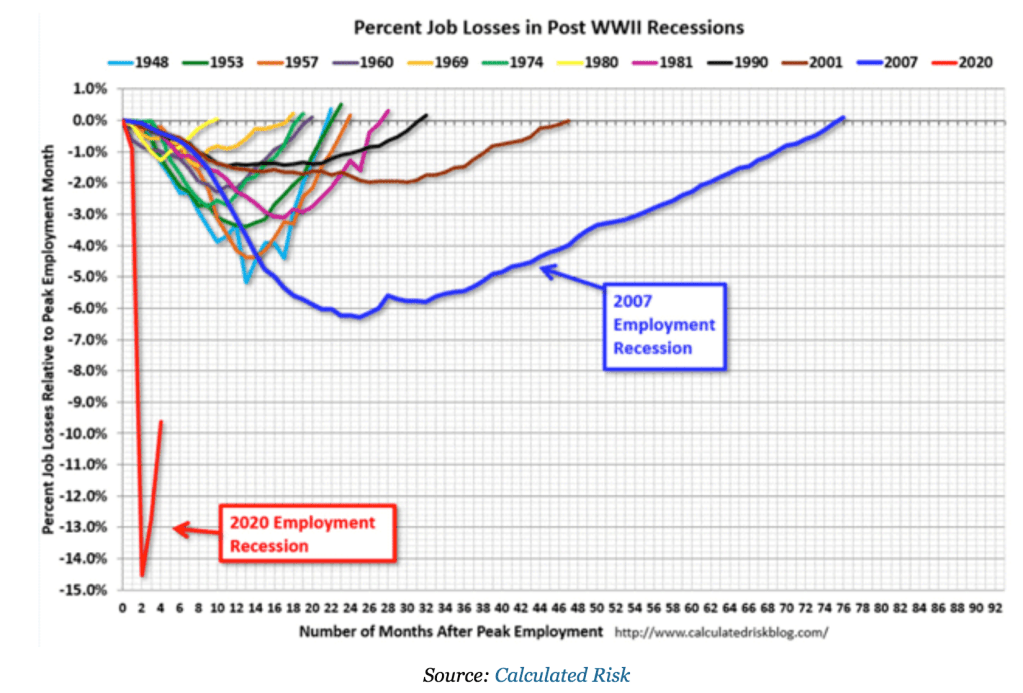
The graph above is from John Mauldin’s latest weekly newsletter, Stumble-Through Jobs Market. This graph really helps to give some perspective to the magnitude of job losses in the U.S. since the pandemic hit. Yes, there are a lot of job losses that are temporary this time, certainly more than in past recessions. However, even if a majority are temporary, we will still have a significant number of permanent job losses. Also, check out 2007, previously the highest number of job losses in a recession since World War II. It took around 6 years from the beginning of the recession before employment recovered to the same level, and close to 4 years from the peak unemployment level. Here is John’s take on the graph above:
…You can see in the 2007 line how long it took employment to recover after the last recession. At that pace, all the jobs will be back sometime in 2026 (Not a typo.) To assume the “V” seen above will continue in the same direction means thinking there will be a quick return to normalcy.
And maybe this time is different since at least some of the layoffs were temporary. The BLS data tries to distinguish between temporary and permanent job losses. That’s a moving target because employers don’t always know. They furlough people with the intent of bringing them back, but then find conditions don’t allow it. At some point, temporary job losses can turn into permanent ones…
This time around, we have seen the same percentage of permanent job losses in 4 months that took nine months in 2007, and over a year in the 2001 recession. There is every reason to think it will get worse before getting better. And it will get better…but probably not soon.
John Mauldin, Stumble-Through Jobs Market, July 11, 2020
I came across another article on June 26 discussing the unemployment claims and the prospects for a quick recovery:
Economists said the sluggish improvements dim prospects for a quick recovery. Further, a recent increase in coronavirus cases could affect efforts to reopen the economy–and get people back to work and spending money.
“We’re seeing a slowdown in layoffs, but hiring hasn’t picked up a tremendous amount,” said Nick Bunker, economist at the job site Indeed. “The recovery from this is going to potentially be a very long slog if we can’t get the virus under control quickly.”
…Macy’s Inc. is laying off about 3,900 corporate staffers as the retailer confronts a slow recovery.
“New Jobless Claims Hold at High Level, Signaling Long Slog,” Sarah Chaney, Wall Street Journal, June 26, 2020.
Earnings season for the second quarter kicks off this week, so we have only seen a trickle of earnings releases so far. So in the next 6-8 weeks we will learn much more about the true business impact of the pandemic shutdown and get a read on whether companies are seeing a significant improvement now that businesses and the economy are starting to open up. I plan to follow these releases closely to see if my pessimistic view is accurate or not.
The Bubble/Warning
One of my favorite reads is Sven Henrich, aka the Northman Trader. For anyone who has an interest in financial markets, I highly recommend you check out his website, http://www.northmantrader.com. He usually publishes a free article once every week or two, and he also posts a free video most weekends. His note on July, 6, called The Bubble, was a great note. In it he described how the Fed has created another market bubble with their recent actions to introduce massive liquidity into the economy.
At this stage markets are basically just a liquidity meth lab, an artificial behemoth constructed and subsidized by the Fed stepping in on any downside in markets. Following $3 trillion in liquidity injections in 3 months ($12 million annualized) markets have entirely disconnected from the economy and any traditional valuation metrics. The Fed’s role in managing markets is becoming ever larger and has now expanded into buying $AAPL [Apple] and $VZ [Verizon] bonds among others in addition to monetizing US debt. Call it what you like, just don’t call it capitalism, rather a nationalization of sorts.
The Bubble, Sven Henrich, July 6, 2020
That was the opening paragraph of the article. Wow, talk about hitting the nail on the head. Make no mistake, it is the Fed driving the stock and bond markets now, and nothing else. It is no secret. There is no one who denies this is the case. Unfortunately, this creates huge distortions in the market where economic fundamentals no longer matter.
Wall Street analysts have largely been made obsolete as earnings growth metrics have long been rendered irrelevant with everybody bowing to the Fed put as the primary reason for buying stocks.
Cases in point: The 2019 rally didn’t kick off until the Fed expanded its balance sheet via repo beginning in September 2019 and markets rallied 30% on zero earnings growth. The 2020 crash didn’t stop until the Fed went into QE unlimited mode, and the current rally stopped on June 8th for the broader market during the same week the Fed’s balance sheet peaked. Negative earnings growth for 2020 yet $SPX [S&P 500] is now flat on the year. Nothing happened. Nothing matters.
With no earnings growth during both years it is folly to pretend markets are about anything else but the Fed.
The state of affairs: The unemployed and poor are dependent on government handouts, the middle class is sweating staring at permanent job losses mounting as the top 1% and billionaire stock owner class is subsidized by the Fed as stocks keeps rising despite the worst economic backdrop in decades. All the while the Fed is steadfastly denying against all evidence that it is contributing to ever expanding wealth inequality even though that is precisely what it is doing.
The Bubble, Sven Henrich, July 6, 2020
Isn’t it reassuring that the 1% are being taken care of with the inflated stock market while the rest of us do our best to survive the current economic chaos. I cannot even watch Jerome Powell testify in front of Congress and deny that Fed policy is THE cause of wealth inequality in the U.S. Sven next covers the real drivers of the market rebound since March has all been due to the large tech stocks that are absolutely killing it, while all of the non-tech sectors are barely treading water.
But tech is increasingly dangerous and the bifurcation in market performances getting ever more apparent, a point I highlighted this morning on CNBC.
In equal weight there is truth I mentioned, highlighting the great distortion in markets. On equal weight basis the S&P 500 is actually sitting a the December 2018 lows when $SPX was trading at 2350.
The disconnect of course is driven by the Nasdaq which now has 7 stocks equaling $6.75 trillion in market cap hiding that most indices are in substantially worse shape than is advertised.
The message: The real economy is in much worse shape and the presumed “V” is not confirmed by the bond market or the banks. In fact the contrast in performance between the banking index and the tech sectors couldn’t be more crass…
Which brings me to tech itself. Overvalued and over owned. Massive valuation expansion over the past year.
The Bubble, Sven Henrich, July 6, 2020
Sven followed that note up with one this week titled Warning, where he discusses the warning signs he sees in the bubbly markets.
I know, we live in the age where trillions are tossed around like candy by central banks and governments and everybody’s eyes just glaze over as the numbers defy context and comprehension.
But let me throw a bit of reality into the mix and it’s absolutely mind boggling.
5 stocks have just added over half a trillion in market cap in just 6 days. Six days. Ponder that.

And they’re even higher on the open today.
5 stocks now have a combined market cap over $6.5 trillion. These very same stocks have added over $1.6 trillion in market cap in 2020. That would be a feat during any bull market during times of great growth, but in a historical recession?
So some of these stocks grabbed some market share during the shutdown, but don’t tell me $AAPL sold more phones during this.
It gets worse. Since 2019 these stocks have added over $3.2 trillion in market cap:

Now, if you can convince yourself to believe that these stocks have earnings growth stories to support market cap expansions anywhere near these figures I suppose you can convince yourself to believe anything.
During bubbles people will convince themselves of anything. And this is nothing new. After all people convinced themselves that tech’s valuations versus the rest of the economy were justified before. How did that work out?
Folks, we are witnessing the greatest market cap expansion in human history making the year 2000 look like child’s play. The combination of insane liquidity thrown at markets, the mechanics of automatic ETF allocations, retail and FOMO thirsty funds chasing these few stocks all look to contribute to the greatest market cap bubble in history.
Warning, Sven Henrich, July 9, 2020
Backing Sven’s view, I just read an article today about a CNBC interview with Mike Novogratz, billionaire investor and founder of Galaxy Digital, who had this to say about today’s markets:
We are in irrational exuberance – this is a bubble. The economy is grinding, slowing down, we’re lurching in and out of COVID, yet the tech market makes new highs every day. That’s a classic speculative bubble.
Interview with Mike Novogratz, CNBC (h/t ZeroHedge)
And ZeroHedge had this commentary on Mike’s interview:
Echoing what BofA CIO Michael Hartnett said on Friday, when he cautioned that the disconnect between macro and markets has never been greater, which however is to be expected now that “government and corporate bonds have been fixed (“nationalized”) by central banks, so why would anyone expect markets to connect with macro, why should credit & stock price rationally,” Novogratz – like Stan Druckenmiller and David Tepper – has been sounding alarms about the stock market for months, yet the S&P 500 index has inched higher, erasing losses spurred by the coronavirus pandemic and notching its best quarter since 1998.
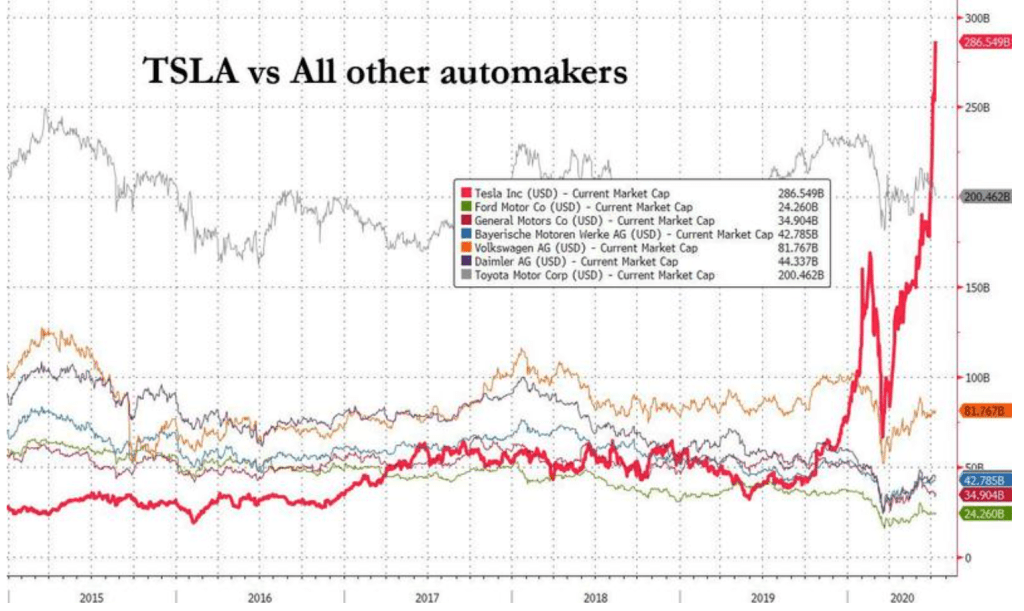
While so far Novogratz’ warnings have fallen on deaf ears, with Robinhooders clearly chasing momentum in such mega-bubble stocks as Tesla…whose market cap is now greater than that of Ford + GM +BMW + Daimler + Volkswagen combined…the man who made a killing buying bitcoin and ethereum ahead of the heard, said that the surge in equities, especiallly tech stocks, reminds him of the rally in Bitcoin prices in 2017, when the cryptocurrency went from $8,000 to almost $20,000 within a couple months due to retail interest…before crashing just as fast. It now trades at roughly half the price it reached during the December 2017 peak.
ZeroHedge, July 12, 2020


Recession or Depression?
On June 24, the UCLA Anderson School of Management released its June quarterly UCLA Anderson Forecast on the outlook of the U.S. economy. This regularly scheduled release came after they revised their first quarter report for the first time in its 68-year history due to the shutdown of the economy as a result of the pandemic. And it sounds like the outlook for the U.S. economy just keeps getting worse.
Now, in its second quarterly forecast of 2020, the Forecast team states that the global health crisis has “morphed into a Depression-like crisis” and that it does not expect the national economy to return to its 2019 fourth-quarter peak until 2023
Press Release – UCLA Anderson Forecast, June 24, 2020
So let’s add this to the pile of evidence that the “V-shaped recover is just not going to happen. Their report had this to say about the U.S. economy:
“To call this a recession is a misnomer. We are forecasting a 42% annual rate of decline in real GDP for the current quarter, followed by a Nike swoosh’ recovery that won’t return the level of output to the prior fourth quarter of 2019 peak until early 2023,” writes the UCLA Anderson Forecast senior economist David Shulman in an essay titled “The Post-COVID Economy.”
“On a fourth-quarter-to-fourth-quarter basis, real GDP will decline by 8.6% in 2020 and then increase by 5.3% and 4.9% in 2021 and 2022, respectively,” he writes.
Shulman goes on to write that U.S. employment will not recover until “well past 2022” and that the unemployment rate, forecast to be about 10% in the fourth quarter of 2020, will still exceed 6% in the fourth quarter two years later. “For too many workers, the recession will linger on well past the official end date,” Shulman writes.
Shulman’s essay notes that the Federal Reserve acted with unusual alacrity by moving immediately to a near-zero interest rate policy and committing itself to supporting the corporate bond market, among other actions, and that the $1.8 trillion CARES Act moved quickly through Congress. He suggests that more relief will be needed this summer, and although a recovery is eventually forecast, it is expected to be moderate.
“Simply put, despite the Paycheck Protection Plan, too many small businesses will fail and millions of jobs in restaurants and personal service firms will disappear in the short run. We believe that even with the availability of a vaccine, it will take time for consumers to return to normal,” Shulman writes. He also states that the housing sector will be a lone bright spot in the recovery.
The forecast notes that while the economy seems to have hit bottom, it will take a while before GDP and employment levels reach fourth-quarter 2019 levels, as the huge debt buildup in both the public and private sectors dampen output. Looking beyond the forecast horizon of 2022, the pandemic has accelerated economic trends that were already moving toward increased digitization of business functions and online commerce.
“It has increased already-rising tensions with China and brought the E.U. closer together,” Shulman writes. “A major response to the pandemic has been the success of work-from-home, which looks like it will lead to long-term changes in the work and urban environments as workers avail themselves of more work/life options. In a nutshell, economic and housing activity will shift from large cities to mid-sized cities and away from the urban centers to the suburbs.
Press Release – UCLA Anderson Forecast, June 24, 2020
This article touches on an important point. As you start hearing about the economy recovering in the next few months, remember that this recovery’s starting point is at an extremely depressed level. Never has our global or national economy had an economic shock like we have just experienced. So if we see economic growth in the next few quarters around 5%, that sounds great, but remember we have likely just seen a 30%-40% decline in GDP. So it will take quite a few quarters of 5% growth to get back to where we were at the end of last year.
Conclusion: 2020 Versus 1929
So we have an economy in a severe, unprecedented recession (depression?), and a stock market, driven by a handful of tech stocks, sending the market back up near all-time highs. If you believe, as I do, that this market cannot remain this distorted long term, then the key question is when will it begin reflecting the conditions in the real world? That question is difficult to answer. There is a saying that the Fed can keep stock prices distorted longer than you can remain liquid, which is a warning about trying to time the big moves in the market. I learned long ago that it is a fools errand to try to exactly time market moves, but since I know where it is eventually headed, I can adjust my portfolio for the long term.
I finished reading a very good book about a month ago, Lords of Finance by Liaquat Ahamed. It follows the lives of the heads of the four key central banks (U.S., U.K., France and Germany) from the end of World War I through The Great Depression. This week, I went back and re-read Chapter 16, Into the Vortex, as I see a lot of similarities between today’s market and 1929, when that market bubble reached its peak. There are so many similarities between Davey Day Trader, and the “Robinhood” investors of today, and the numerous novice investors in 1929 who had that well-known Fear of Missing Out (FOMO) and invested in the market as it reached its peak.
The author starts the chapter with the following quote: “At particular times a great deal of stupid people have a great deal of stupid money…At intervals…the money of these people–the blind capital, as we call it, of the economy–is particularly large and craving; it seeks for someone to devour it, and there is a “plethora”; it finds someone, and there is “speculation”; it is devoured, and there is “panic.”–WALTER BAGEHOT
Let’s pull out a few excerpts from this chapter of the book, and see if you spot any similarities:
…while it was possible to predict the factors that caused any given stock to rise or fall, the overall market was driven by the ebb and flow of confidence, a force so intangible and elusive that it was not readily discernible to most people. There would be no better evidence of this than the stock market bubble of the late 1920s and the crash that would follow it.
The bubble began, like all such bubbles, with a conventional bull market, firmly rooted in economic reality and led by the growth of profits…
The first signs that other, more psychological, factors might be at play emerged in the middle of 1927 with the Fed easing after the Long Island meeting. The dynamic between market prices and earnings seemed to change. During the second half of the year, despite a weakening in profits, the Dow leaped from 150 to around 200, a rise of about 30 percent.
Lords of Finance
One big difference between past stock market bubbles and our current bubble is this one really didn’t start with a conventional bull market. Our current “bull” market has been driven by Fed liquidity, not economic reality. The big market distortions really started after the 2008 crisis, and growth since then has been very anemic.
It was in the early summer of 1928, with the Dow at around 200, that the market truly seemed to break free of its anchor to economic reality and began its flight into the outer reaches of make-believe…
That it was so obviously a bubble was apparent not simply from the fact that stock prices were now rising out of all proportion to the rise in corporate earnings–for while stock value were doubling, profits maintained their steady advance of 10 percent per year. The market displayed every classic symptom of mania: the progressive narrowing in the number of stocks going up, the nationwide fascination with the activities of Wall Street, the faddish invocations of a new era, the suspension of every conventional standard of financial rationality, and the rabble enlistment of an army of amateur and ill-informed speculators betting on the basis of rumors and tip sheets…
Trading stocks had become more than a national pastime–it had become a national obsession.
Lords of Finance
When I read “progressive narrowing in the number of stocks growing up,” I immediately remembered reading Sven’s article that discussed the big tech stocks, Microsoft, Amazon, Apple, Alphabet, and Facebook, being stocks that are driving this market higher. And what better way to describe Davey and the gang that a “rabble enlistment of an army of amateur and ill-informed speculators”? The similarities are almost scary! I am not sure I could describe todays environment as a national obsession, but it certainly is for a rather large segment of our population.
Anyone trying to throw doubt on the reality of this Promised Land found himself being attacked as if he had blasphemed about a religious faith or love of country.
As the crowd piling into the market grew, brokerage house offices more than doubled…These “board rooms” became substitutes for the bars shut down by Prohibition–the same swing doors, darkened windows, and smoke-filled rooms furnished with mahogany chairs and packed with all sorts of nondescript folk from every walk of life hanging around to follow the projected ticker tape flickering on the big screen at the front of the office.
Lords of Finance
So, an interesting parallel occurred to me when I read this today. In 1929, the brokerage houses became a substitute for the bars that had been closed due to Prohibition. And today, the stock market has become a substitute for sports gamblers who no longer have sports in which to bet on. I guess when our vices are taken away, we always find a replacement, but I had no idea how the stock market has taken the place of these vices on more than one occasion!
And you are attacked today if you criticize Davey and his crowd. Just ask Howard Marks.
The newspapers were full of articles about amateur investors who had made fortunes overnight.
The old crowd on Wall Street had a rule that a bull market was not in full stampede until it was being played by “bootblacks, household servants, and clerks.” By the spring of 1928, every type of person was opening a brokerage account–according to one contemporary account, “school teachers, seamstresses, barbers, machinists, necktie salesmen, gas fitters, motormen, family cooks, and lexicographers.” Bernard Baruch, the stock speculator who had settled down to a life of respectability as a presidential adviser, reminisced, “Taxi drivers told you what to buy. The shoeshine boy could give you a summary of the day’s financial news as he worked with rag and polish. An old beggar, hwo regularly patrolled the street in front of my office, now gave me tips–and I suppose spent the money, I and others gave him, in the market. My cook had a brokerage account.”
The stock pronouncements of shoeshine boys would become forever immortalized as the emblematic symbol of the excesses of that period. Most famously, Joseph Kennedy decided to sell completely out of the market when in July 1929, having already liquidated a large portion of his portfolio, he was accosted by a particularly enthusiastic shoeblack on a trip downtown to Wall Street, who insisted on feeding him some inside tips. “When the time comes that a shoeshine boy knows as much as I do about what is going on in the stock market,” concluded Kennedy, “it’s time for me to get out.”
Lords of Finance
And when an owner of a sports gambling website becomes the preeminent stock picker of 2020, maybe it’s time to move investments to the sideline and wait until the implosion clears.
The new folk heroes of the market were the pool operators, a band of professional speculators analogous to the hedge fund managers of today. They were typically outsiders, despised by the Wall Street establishment, who accumulated their fortunes–though they would soon enough lose them–by betting on stocks with their own and their friends’ money.
Lords of Finance
And the key phrase is “though they would soon enough lose them.” Market bubbles never end well. And unfortunately, it is typically those who are novices, trying for the first time to bet on the market, who lose out. I am hearing a lot that the market professionals are either sitting on the sidelines during the current market rally, or they are hedging their positions to protect their investments from a downside shock. And there is a reason they are doing this.
No doubt, with the Fed continuing to pump liquidity that finds its way into the markets, this rally could go on much longer than many believe possible. In many respects the stock market is driven by confidence, and right now most investors believe the Fed has their back and will provide support to the markets at any sign of a downturn. And so far they have been correct.
The challenge is understanding when you should get out. When does that confidence in the “Fed put” start waning? Who knows? But my strong advice is to trade carefully.

 Seay Economics