Should we be bracing for inflation or deflation?

One of the more fascinating debates in the financial world for me the past few months is a debate regarding whether we are heading toward inflation or deflation. I follow many smart economists and market experts on both sides of this argument. After reading a lot of research papers with arguments on both sides, I am starting to form an opinion of my own. However, let’s start with a little background first.

Deflation since 2008

Back in 2011-2012, when I was just starting my education into macroeconomics, I became convinced that the Fed’s quantitative easing policies would lead to inflation. This view was a direct result of the finance and market “experts” I was following at the time. In fairness, there were a lot of smart people who got it wrong back then. I learned from that experience that economics is more complex and difficult to predict than you might imagine. It is not a science like physics or chemistry with certainty of principles, but in fact is more of a behavioral science. It was a painful lesson for me, with my portfolio suffering the consequences!

So where did those that I followed at the time get it wrong? I believe there were a couple of fallacies in that line of thinking. First, a lot of the liquidity that was generated by the Fed through the various rounds of QE did in fact cause inflation, but inflation of the financial markets, not the economy and consumer prices. The stock market rebounded from the late 2000s lows in large part due to the liquidity provided by the Fed and other central banks.

The other issue I did not discover until more recently, as I found more credible economists from which to learn. When central banks provide liquidity through quantitative easing, that liquidity does not necessarily find its way into the economy. And here is why. Remember, a central bank’s primary role is to provide liquidity, or in other words, funds available for loans, to regular banks. The idea is the additional availability of those funds will provide the ability of banks to provide financing for businesses. These loans will then go to businesses that will invest the loan proceeds in productive investments, thereby stimulating economic growth. And with that comes jobs growth, thereby pulling the country out of the recession. As economic growth ramps up and unemployment drops, this typically results a rise in prices as there are fewer workers for all of these new jobs.

However, there is one little flaw in this line of thinking. No matter how much liquidity the Fed makes available to the banking system, there is nothing to force those banks to suddenly increase the amount of loans they are willing to make. Remember, when a bank makes a loan, the bank takes on repayment risk. Unless the bank is confident that borrowers can repay, then they do not have an incentive to make these loans. This was the missing link in the aftermath of the Global Financial Crisis for many forecasters.

The other challenge with creating inflation is that there are forces in the U.S. and most other developed markets today that are deflationary, with the primary force being the gentrification of the population and workforce. The developed world is aging. The baby boomers have been reaching retirement age for about 15 years now, so we are losing their productivity in the workforce. And compounding the problem, birth rates across developed markets has been on the decline for a number of years. So demographic forces today are extremely deflationary, as productivity and consumer demand drop.

The Fed’s policy shift

As an interesting aside, the Fed, in just the past two weeks, has made a significant shift in their mandate of stable prices. For a number of years, the Fed has interpreted this mandate as keeping inflation at no greater than 2% per year. In the past, the Fed would raise interest rates as the economy heated up in order to control inflation. This is typically called tightening. And as the business cycle played out, the Fed would tend to over-tighten, cutting off economic growth and pushing the economy into a recession. Interest rates would then be lowered to stimulate economic growth, starting the cycle over again.

On August 27, Fed chairman Jerome Powell made his annual speech in Jackson Hole, laying out a significant change in the future in regards to controlling inflation.

In a speech Thursday morning, Powell acknowledged the painful lessons of runaway inflation in the 1970’s, but warned that the persistence of low inflation over the last eight years risks new economic difficulties.

“Many find it counterintuitive that the Fed would want to push up inflation,” Powell said. But the Fed chief warned that low inflation leads to declining inflation expectations, which has the effect of “diminishing our capacity to stabilize the economy through cutting interest rates.”

The Fed’s target for inflation is 2%, measured as core personal consumption expenditures (which excludes volatile components like energy and food prices). But since establishing that goal in its 2012 Statement on Longer-Run Goals and Monetary Policy Strategy, the Fed has averaged inflation of only about 1.6%, touching 2% only briefly in 2018.

In 2019, the Fed launched a nationwide listening tour to see if it could tweak its statement with the objective of nudging inflation up toward its target.

On Thursday morning, Powell announced the conclusion of that review and said the policy-setting Federal Open Market Committee had unanimously approved new language that would allow for inflation moderately above 2% “for some time” following periods where inflation “has been running persistently” below that target.

Yahoo News, August 27, 2020 https://news.yahoo.com/jackson-hole-powell-unveils-effort-to-target-moderately-higher-inflation-131005405.html

For those of you who do not follow the Fed, here is a word of caution: They like to lie Don’t always believe what they say. So first, it is important to know that their measure of inflation, PCE, is crap not reality. Just in the quote above, it excludes energy and food. What? Does your family spend money on food? How about gas for the car? How convenient to just ignore this. How about spending on healthcare? Well, PCE bases health care costs only on medicare rates. Health insurance premiums? Ignored. Has that increased in price for your family recently? How about college tuition for the kids? Also ignored. So it is safe to say that the Fed’s inflation calculation of 1.6% inflation per year recently is actually quite bogus and severely understated.

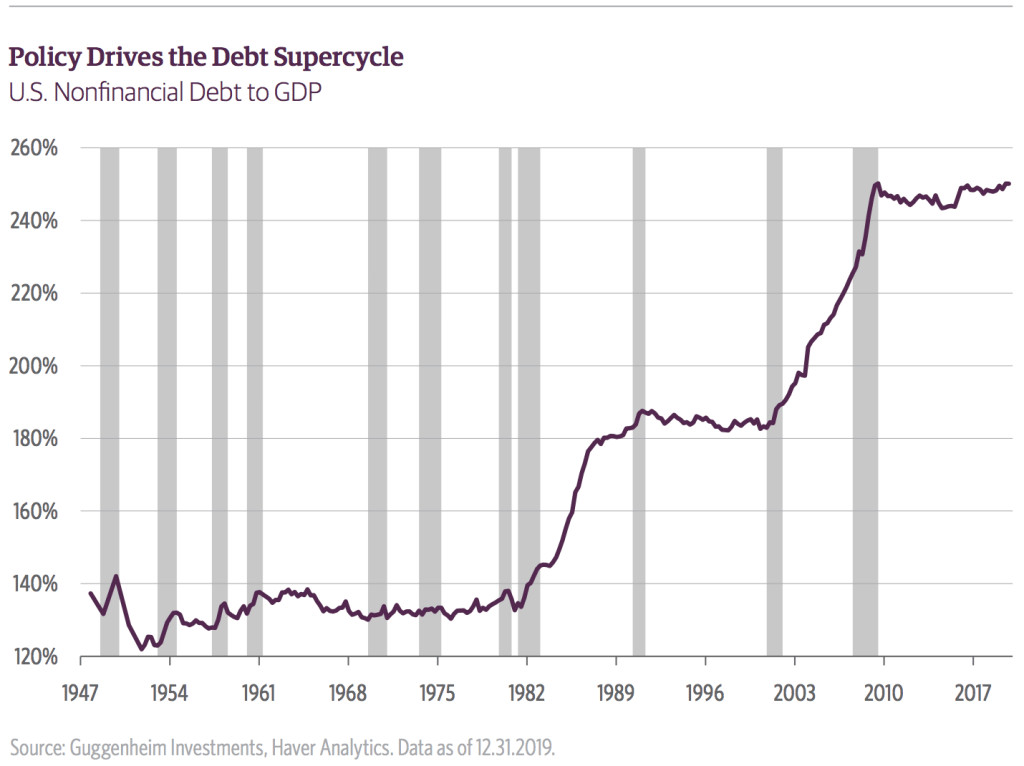
So next question, why do you think the Fed wants to push inflation up? First, here’s a dirty little secret. A better way to think of inflation is not an increase in prices. It is really a devaluation/debasement of our currency. That’s right, the good ole US dollar. So why devalue our currency? Well, take a look at the government’s balance sheet. We have run deficits for many years, and liabilities are skyrocketing this year to unprecedented levels. And there is no better way to minimize future debt servicing payments than to have a little high inflation/currency debasement.

I remember the first time I found out the amount of my parent’s house payment. It was probably around 1982. It was $88 a month! The house had been purchased in 1967, prior to the high inflation that occurred in the 1970’s. And you can bet that the house payment was much more of a stretch for my parents in the late 1960s than it was in 1980. That is the power of inflation on your debt.

But the flip side is that this phenomenon is just the opposite for savers. Quite frankly, savers get screwed when inflation increases. The spending power of their savings decreases year after year with high inflation. This is especially challenging for our seniors, who have no ongoing income and fixed savings and/or income.

In this week’s Thoughts From the Frontline newsletter from John Mauldin, titled “Inflation Virus Strikes Fed,” he addresses this policy change at the Fed. I have included a link to the newsletter for you to read in full (I highly recommend), so I will skip to John’s final thoughts on this change in inflation policy at the fed:

A few thoughts on the Fed’s twisting the concept of stable prices into a 2% inflation goal.

1. As noted above, 2% inflation cuts the buying power of your savings in half in just 36 years. Combined with a 0% interest rate policy, it means retirees following safe and prudent standards are guaranteed to lose buying power.

Whether you are just beginning to save for retirement, or you are already retired, such a policy makes you run faster just to stay in the same place. Yes, I understand that in a heavily indebted nation there is a perceived “need” for some level of inflation to lower the burden of debt. But lowering one man’s debt burden simultaneously reduces another man’s buying power.

All the words that the Federal Reserve used to describe this new policy never reveal exactly what time period they will use to achieve “average” 2% inflation. That makes a huge difference. It could mean letting run a, say, 4% for several years while keeping short-term interest rates near zero. Does anyone seriously believe that will have no consequence?

2. It follows from the above that at 4% inflation, longer-term interest rates would rise. This, of course, is not what the Fed wants. There is another “policy” being discussed in academic circles today: yield curve control. Will they have to control government rates all along the curve? That will have consequences too.

Further, the Fed now owns about a third of all US securitized mortgages. One. @#$%5ing. Third. Great for homebuyers. Will they continue this policy? How long? Will the US securitized mortgage market become like the Japanese bond market? That is to say, controlled by the central bank? The Federal Reserve is not buying jumbo loans. Does that mean jumbo loans will rise with inflation, shutting out wealthier people from buying homes, or at least larger homes, and driving down those home prices? Unintended consequences…

This massive manipulation of the bond market and the most important price in the world, the interest rate of the global reserve currency, is nothing but plain and simple price control. Can someone show me an instance where significant price controls actually worked over the long-term? Especially in a market this big? In the world’s reserve currency?

3. Which brings us to another unintended consequence, or at least I assume it is unintended. This is going to have a result of putting significant downward pressure on the dollar, causing commodity prices and US consumer prices to rise and exporting deflation to the rest of the world. The Aussie dollar is already up by 27%. The Europeans are complaining.

4. It is clear that the extraordinary quantitative easing has boosted equity prices. Not to mention home prices. That means that those with homes and equities have seen their net worth increase. For most of us reading this letter, that’s a good thing. But it also increases wealth and income disparity, which is tearing at the nation’s psychological roots. I don’t believe anyone at the Federal Reserve wants to increase wealth disparity, but that is the clear and obvious unintended consequence/result of their policy.

5. My friend David Bahnsen highlighted another point in a recent market commentary (emphasis mine):

But the impact of present Fed policy on the stock market extends well past the zero interest rate policy. In fact, rate policy has not even been the monetary tool that has most impacted the markets. The explosive interventions into debt markets, either through direct bond purchases (quantitative easing) or liquidity provisions (commercial paper, corporate debt, asset-backed securities) has had an incalculable impact on equity markets.

“Besides the basic reality of $3 trillion (and counting) of new reserves in the banking system and liquidity that finds its way into financial assets far easier than it does the real economy, how significant is it to corporate profitability to have borrowing costs reduced to their lowest level in history? Fed interventions in the corporate bond market (shockingly, both investment grade and high yield) have created extraordinary access to capital for companies that know how to use that capital quite productively.

This pendulum shift cannot be overstated–many companies went from challenging business conditions with high cost of debt and limited access to new debt that they needed for this difficult time, to instead, less challenging conditions with brutally low cost of debt and unlimited access to capital needed for this time and useable for growth measures after this time. That shift from ‘what could have been’ to ‘what is’ in credit markets is the most underappreciated factor driving equity markets today.”

6. The combined impact of all this means that the Federal Reserve is putting its thumb on the scale between Wall Street and Main Street, between the haves and have-nots, between the wealthy and the middle class, let alone the poor. Not the intent, I get that. Powell and company are doing what they think will keep the economy moving forward. But intended or not, the consequences are still there. Is the average man on the street unjustified in thinking that “the elites,” whatever the hell that means, are not looking out for his best interest? When a struggling corporation accesses the debt markets because the Federal Reserve made it easy to do so, they are acting in the best interest of their shareholders. They are simply trying to stay afloat in a crisis. But restaurants, hair salons, and small businesses in general don’t have that same access because they don’t have the same experience or connections.

Thoughts From the Frontline, John Mauldin, 9/4/2020 https://www.mauldineconomics.com/frontlinethoughts/inflation-virus-strikes-fed

I covered some of John’s last point in my last article, and I must admit that reading it gets my blood boiling again. Our government is not doing much of anything helpful for our small businesses, which are critical for our economy, while on the other hand they are making funding more affordable and easily obtainable for larger corporations. The rich get richer…you know the rest. And you wonder why many in society are upset with the lack of justice and equality in our society? Somebody in our government had better wake up to the reality on main street USA. John summarizes my feelings in a much more diplomatic way.

We have come to this because a progression of “policy” decisions by the Federal Reserve and the US government backed us into a corner. No matter who wins the election in November, they will have no good choices. A $2 trillion deficit is not a good choice. And $2 trillion may not be enough to keep the wheels from falling off the economy.

Small business America is getting slammed. It is clear that at least 100,000 small business will permanently close. That number could double over the next year. Every one of those businesses represents jobs, including many jobs for lower income Americans. Which is where the brunt of this crisis is being directed.

Thoughts From the Frontline, John Mauldin, 9/4/2020

Beware inflation

So, to recap, although there are certainly deflationary forces, primarily in the form of unfavorable demographics, in play, we see our government has motivation, desire, and the beginnings of a plan to create higher inflation. So which is it?

There is one big difference for me as I look at the deflation versus inflation argument, between 2008 and now. Back then, the Fed lowered interest rates and flooded the market with liquidity through quantitative easing just as now. But as I learned back then, the Fed cannot really create inflation on its own. Not when banks are hesitant to put that liquidity into action through loans. So what is different this time?

Quite simply, it is the actions of Congress and the President. The CARES act provided direct liquidity into our economy, through things like enhanced benefits for unemployment and other forms of direct financial support. This puts more dollars into our economy without any increase in production or output. So more dollars are chasing the same, or in some cases less, amount of goods available. There are other inflationary forces in play this time as well. We read about supply disruptions as western economies begin to look to cut supply chains emanating from China. This will be much more costly, especially if some of this manufacturing moves back home. So not only will we deal with higher labor and input costs, but product shortages will tend to drive prices higher as well.

This may take some time to materialize, so I am not sure how quickly this will begin to be felt fully. We are already seeing spikes in food prices, but what happens as tariffs for Chinese imports keep going up, or as companies begin to source products from other countries? It seems like more and more forces are aligning to start pushing prices higher.

And we are already seeing the US dollar begin to weaken against quite a few other currencies. This makes imported products more expensive as well. A lot of monetary experts expect this to continue for the foreseeable future. So don’t be surprised if your paycheck begins to be stretched more and more as we move through the next few years.

So, if inflation is coming, what should you do? One thing most prudent people should do is re-evaluate your asset portfolio. The types of investments that do well in inflationary times are precious metals, real estate, and any similar “real,” physical assets. Some stocks will tend to do well in inflationary times, while many others will not. Some bonds, such as TIPS bonds, are inflation-protected. I believe the primary reason gold and silver have performed so well over the past few months is because of this increasing fear of inflation. So it may be time to start thinking about whether a re-balancing of your investment portfolio is due.

PLEASE NOTE: As I am not a licensed investment advisor, please note that this is not investment advice. I suggest you contact your investment advisor for more direct guidance on how to structure your portfolio.

A New Bull Market or a Classic Bull Trap?

Pretty simple guys. Stocks always go up, and even when they don’t they do.

Dave Portnoy, aka Davey Day Trader Global

These days, if you need to be entertained and have a good laugh, all you need to do is get on Twitter and see Davey Day Trader go up against the stock market “experts” and observe the back-and-forth banter. For those of you unfamiliar with Davey, he is Dave Portnoy, the president of Barstool Sports, who in the past spent a lot of his time focused on sports gambling. With no sports to bet on the past few months, and with a new load of cash on hand with the sale of 36% of his business to Penn National Gaming, Davey took up day trading to get his daily gambling fix. If crude language doesn’t bother you, then Davey is a good place to go to get entertained, especially if you follow the stock market.

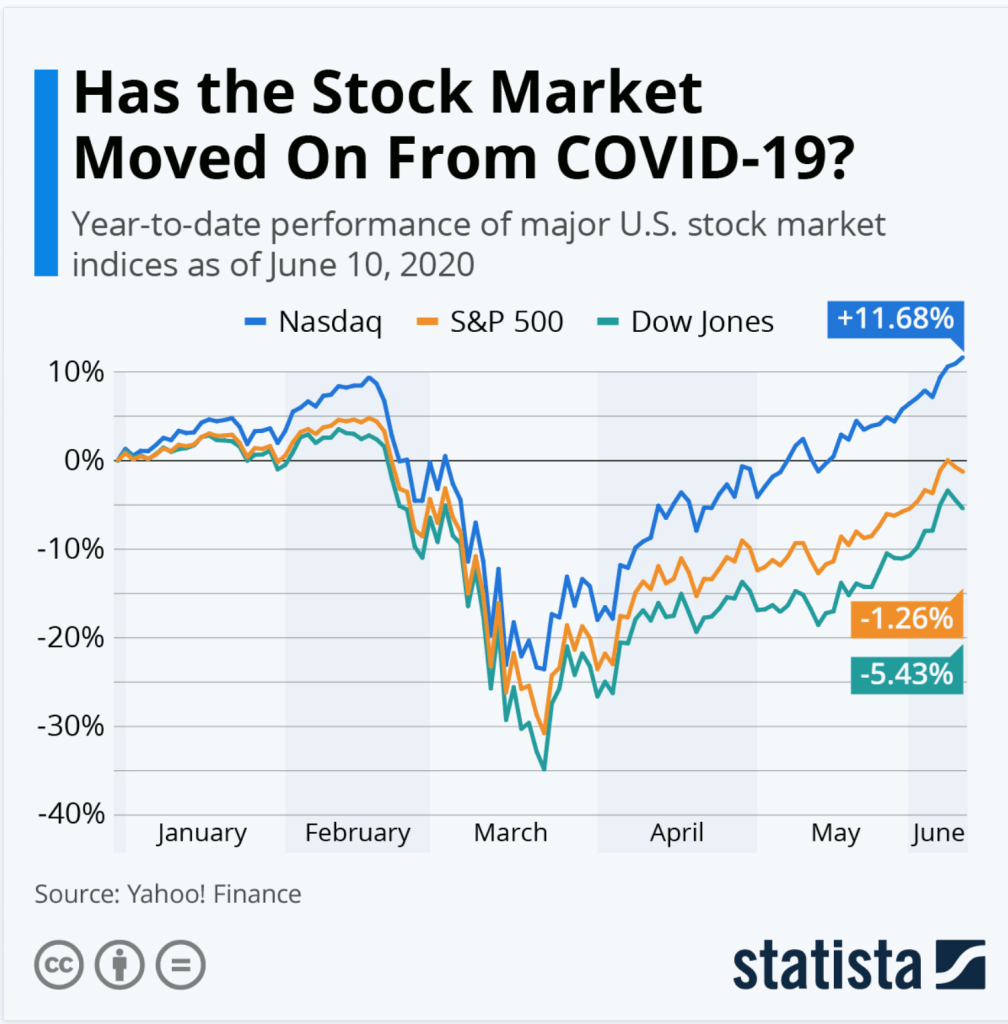
The biggest debate in the financial world today is the age old question of whether the stock market will keep going up, or will we have a repeat of the late February downturn that will ruin the portfolio of Davey Day Trader and his legion of followers. As you know, I follow the markets and the economy closely, and I would put my money on us being in a Bull Trap rather than the start of a new Bull Market.

Bull Market – A bull market is a financial market of a group of securities in which prices are rising or are expected to rise.

Bull Trap – A bull trap is a temporary reversal in an otherwise bear market that lures in long investors who then experience deeper losses.

Investopedia

The key argument that we are in the beginning of a new bull market is driven by the belief that the flood of liquidity coming from central banks is finding its way into the financial markets and will continue to drive increases in stock prices and valuations. And there is merit to this argument, as in recent years there is a strong correlation between central bank-driven liquidity and stock prices. Another argument for a bull market is driven by the belief that the economy will quickly recover from the pandemic-driven shutdown, i.e. experiencing a “V-shaped” recovery.

The key argument that we are in a bull trap is centered on the belief that, over time, stock prices will reflect the strength or weakness of the underlying business conditions, reflected in the increase or decrease in corporate profits. The pandemic has pushed the world economy into a deep recession, and so far the stock market has not taken the drop in GDP into account in stock valuations. Those of us who believe we are in a bull trap are convinced that the economic recovery will not be quick or easy. and will eventually be reflected in business valuations.

If you have read my previous posts, you will know that I fall into the “bull trap” camp. In today’s note I will lay out the reasons I believe there is a high probability that we will see declines that will approach or fall below the March lows. I firmly believe that, over time, the stock market will reflect the economic performance the individual companies included in each exchange, regardless of the Fed’s actions to keep the market bubble inflated. And there is a very low probability that businesses recover quickly from the economic shocks we have endured since the beginning of 2020.

Source: Statista (https://www.statista.com/chart/20939/year-to-date-performance-of-major-us-stock-market-indices/)

Impact of Pandemic Disruptions Will Linger

We have just gone through what appears to be one of the worst economic disruptions in history. The more I read, the more difficult it is for me to wrap my head around how disruptive the past 4+ months have been. One of my favorite financial market experts is John Mauldin of Mauldin Economics. He was one of the first financial commentators I began reading when I started my journey to learn about the economy and markets 10 years ago. In my last blog post I referenced his June 26 newsletter titled A Recession Like No Other. He closed that newsletter with an “instant classic” Twitter post from his daughter Tiffani that sums up, with some levity, what we are going through:

There is a lot of truth in that short post. Not only have we been hit by a pandemic, shutdown of businesses, supply shock, demand shock, protests, riots, etc., etc., etc., but the entire world has been hit by most of these at the same time. This is the stuff that would have made a fantastic end-of-the-world fantasy novel. And I still see financial market experts at the big firms predicting that we will recover from this by the end of the year. To me, this is wishful thinking to the hundredth power. I just cannot see us recovering in less than 2-3 years. And that’s if things go really well.

Why do I think this? Well, as usual my beliefs are shaped by the experts that I follow that make the most logical sense. And over the years I have found some great sources of wisdom that help me figure out where we are likely headed. So let me cover a few of the most impactful writings I have uncovered the past few weeks.

Up first is a July 6 article from Doug Kass, founder and president of Seabreeze Partners Management, Inc., who was bullish back in early March but has changed his view as the market has moved back up near all-time highs.

In aggregate terms, COVID-19 will likely have a sustained impact on the domestic economy – in reduced production and profitability – for several years, and in some industries, forever

Doug Kass, July 6, 2020

Doug then lists his concerns with the economy that will eventually negatively impact the markets.

Important Industries Gutted: Several key labor-intensive industries – education, lodging, entertainment (Broadway events, concerts, movie theatres, sporting events), restaurant, travel, retail, nonresidential real estate, etc. – face an existential threat to their core. For these gutted industries, we face, at best, an 80% to 85% recovery in the years to come. It should be emphasized that in the case of some of these sectors, like retail, Covid-19 sped up what was already a secular decline.

A Negative Knock-On Effect: Tangential industries, like food and other services, that surround less utilized office, mail and other spaces will also get hit. They, too, face at best, an 80% recovery, in the years to come.

Widening Income and Wealth Inequality: The combined unemployment impact will run deepen and cause not only adverse economic ramifications but lead to intensified social imbalances.

A Battered Public Sector: With a lower revenues base, the Federal government and municipalities will be forced to cut services (and unemployment).

Rising Tax Rates and Redistribution: To fund this shortfall, effective tax rates will be steadily rising – exacerbating the disruption above and creating a less than virtuous cycle.

Weak Capital Spending: With a large output gap and higher debt loads ($2.5 trillion of debt has been tacked on to year-end 2019 total non-financial debt of $16 trillion), the outlook for business fixed investment growth appears unappealing over the next several years.

Higher Costs, Lower Profit Margins: The surviving companies in a post Covid-19 world face higher costs of doing business. (Remember Amazon’s $4 billion rise in virus-related costs in its latest reporting quarter?)

The Competitive Influence of Zombie Companies Exacerbates Lower Profitability: Corporations will face further pressure on profit margins from “zombie companies” that compete aggressively on cost and take longer to die because of low interest rates and weak loan covenants.

Small Businesses Gutted: The greatest brunt from the pandemic is faced by small businesses that historically account for the largest job creators.

The Specter of a Secular Erosion in Unemployment: Permanent job losses will be surprisingly large – that’s a consumption killer.

More Cautious Business Confidence and Spending: The surviving companies, ill prepared operationally and financially, in early 2020 for the disruptive impact of Covid-19, will be forced to maintain a “buffer” of additional capital (and cash) in the event of another unforeseen event or tragedy. In all likelihood, this will make for less ambitious capital spending and expansion plans relative to the past.

A Political Stasis: Political divisiveness and partisanship could intensify – dimming the probability of constructive, pro-growth fiscal policy, so necessary in a log growth economy.

Doug Kass, July 6, 2020

Doug wraps up the letter by stating, “These are not the ingredient for a Bull Market or for rising valuations. Rather, the above factors may be an ingredient to:

  1. Increased market volatility.
  2. Rising economic uncertainty and cautiousness in the C-suite.
  3. An unsteady period of growth.
  4. Lower price earnings ratios.
  5. More social unrest.”

All of these challenges, and Doug’s outlook, fit nicely into The Fourth Turning narrative I have been writing about. Fourth Turnings are typically times of unprecedented events taking place that push us into one crisis after another. This is much bigger than just the financial markets, although we can study the markets to see the signs of upcoming events as we move through the Fourth Turning.

Business Bankruptcies and Downsizings

As I predicted in one of my first articles (https://seayeconomics.finance/2020/05/24/get-ready-for-a-tidalwave-of-bankruptcies/), the list of bankruptcies continues to grow.

Bloomberg via ZeroHedge

Bankruptcies are on the rise, with 13 U.S. companies filing in one week in late June, the first week so far this year with more than eight. The sectors with the most filings are, no surprise, the consumer and energy. The highest profile bankruptcy filing in the energy sector Is Chesapeake Energy, a company that pioneered the fracking process to extract natural gas. A Deloitte study found that around 1/3 of U.S. shale producers are technically insolvent with oil prices at $35 a barrel. Oil prices have now climbed just above $40 per barrel, but there is no guarantee they will stay at this level. So more bankruptcies are likely to follow in this sector in the coming weeks.

Other recent bankruptcies, since June 15, include the following companies: 24 Hour Fitness (closing more than 100 of its 400 gyms), Brooks Brothers (closing 51 of 250 stores), Chuck E. Cheese, Cirque de Soleil, GNC (will accelerate closure of 800-1,200 of its 7,300 locations),

And there are companies that, for now at least, are not at risk of filing bankruptcy, but are still downsizing their operations as they figure out ways to survive the economic downturn and challenges in dealing with the fallout from the pandemic. Macy’s has announced a significant number of corporate layoffs. Bed Bath & Beyond announced on Wednesday it would close roughly 200 stores, around 13% of their stores. Their revenue for the quarter ended May 30 dropped 49%. The only good news is most of their stores are now open.

Bankruptcies and Store Closures Lead to PERMANENT Job Losses

There seems to be a belief out there that almost all job losses are just temporary, and furloughed employees will be hired back as businesses reopen and the economy gets re-started. This assumption leads directly to the belief in the “V-shaped” recovery. Sorry, I just don’t see it playing out this way.

If our economy was as strong as some believed as we went into this crisis, then I could have hope that there would be a quick rebound. However, as I have pointed out previously, our economy has been struggling really since the Global Financial Crisis, due to the continued expansion in the amount of debt that has made our economy extremely sluggish. We were headed for a downturn in the market before anyone was discussing COVID-19, and all that was needed was a small trigger to push us into a recession. Instead of a small trigger, we got a bazooka.

Walgreens Boots Alliance announced on Thursday it plans to eliminate about 4,000 jobs in the U.K., after announcing a quarterly loss of $1.71 billion, compared to a profit last year of $1.03 billion. Sales versus last year were flat, but the company estimated the pandemic cost them $700 to & $750 million in lost sales. And this is a retailer that was able to keep most units open during the past few months.

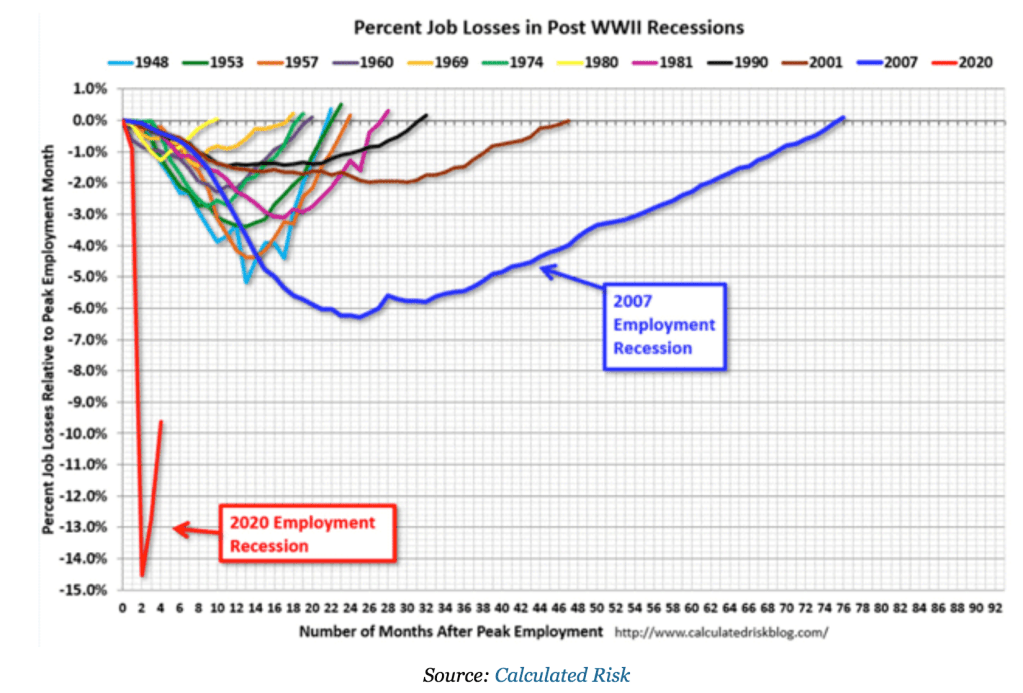
The graph above is from John Mauldin’s latest weekly newsletter, Stumble-Through Jobs Market. This graph really helps to give some perspective to the magnitude of job losses in the U.S. since the pandemic hit. Yes, there are a lot of job losses that are temporary this time, certainly more than in past recessions. However, even if a majority are temporary, we will still have a significant number of permanent job losses. Also, check out 2007, previously the highest number of job losses in a recession since World War II. It took around 6 years from the beginning of the recession before employment recovered to the same level, and close to 4 years from the peak unemployment level. Here is John’s take on the graph above:

…You can see in the 2007 line how long it took employment to recover after the last recession. At that pace, all the jobs will be back sometime in 2026 (Not a typo.) To assume the “V” seen above will continue in the same direction means thinking there will be a quick return to normalcy.

And maybe this time is different since at least some of the layoffs were temporary. The BLS data tries to distinguish between temporary and permanent job losses. That’s a moving target because employers don’t always know. They furlough people with the intent of bringing them back, but then find conditions don’t allow it. At some point, temporary job losses can turn into permanent ones…

This time around, we have seen the same percentage of permanent job losses in 4 months that took nine months in 2007, and over a year in the 2001 recession. There is every reason to think it will get worse before getting better. And it will get better…but probably not soon.

John Mauldin, Stumble-Through Jobs Market, July 11, 2020

I came across another article on June 26 discussing the unemployment claims and the prospects for a quick recovery:

Economists said the sluggish improvements dim prospects for a quick recovery. Further, a recent increase in coronavirus cases could affect efforts to reopen the economy–and get people back to work and spending money.

“We’re seeing a slowdown in layoffs, but hiring hasn’t picked up a tremendous amount,” said Nick Bunker, economist at the job site Indeed. “The recovery from this is going to potentially be a very long slog if we can’t get the virus under control quickly.”

…Macy’s Inc. is laying off about 3,900 corporate staffers as the retailer confronts a slow recovery.

“New Jobless Claims Hold at High Level, Signaling Long Slog,” Sarah Chaney, Wall Street Journal, June 26, 2020.

Earnings season for the second quarter kicks off this week, so we have only seen a trickle of earnings releases so far. So in the next 6-8 weeks we will learn much more about the true business impact of the pandemic shutdown and get a read on whether companies are seeing a significant improvement now that businesses and the economy are starting to open up. I plan to follow these releases closely to see if my pessimistic view is accurate or not.

The Bubble/Warning

One of my favorite reads is Sven Henrich, aka the Northman Trader. For anyone who has an interest in financial markets, I highly recommend you check out his website, http://www.northmantrader.com. He usually publishes a free article once every week or two, and he also posts a free video most weekends. His note on July, 6, called The Bubble, was a great note. In it he described how the Fed has created another market bubble with their recent actions to introduce massive liquidity into the economy.

At this stage markets are basically just a liquidity meth lab, an artificial behemoth constructed and subsidized by the Fed stepping in on any downside in markets. Following $3 trillion in liquidity injections in 3 months ($12 million annualized) markets have entirely disconnected from the economy and any traditional valuation metrics. The Fed’s role in managing markets is becoming ever larger and has now expanded into buying $AAPL [Apple] and $VZ [Verizon] bonds among others in addition to monetizing US debt. Call it what you like, just don’t call it capitalism, rather a nationalization of sorts.

The Bubble, Sven Henrich, July 6, 2020

That was the opening paragraph of the article. Wow, talk about hitting the nail on the head. Make no mistake, it is the Fed driving the stock and bond markets now, and nothing else. It is no secret. There is no one who denies this is the case. Unfortunately, this creates huge distortions in the market where economic fundamentals no longer matter.

Wall Street analysts have largely been made obsolete as earnings growth metrics have long been rendered irrelevant with everybody bowing to the Fed put as the primary reason for buying stocks.

Cases in point: The 2019 rally didn’t kick off until the Fed expanded its balance sheet via repo beginning in September 2019 and markets rallied 30% on zero earnings growth. The 2020 crash didn’t stop until the Fed went into QE unlimited mode, and the current rally stopped on June 8th for the broader market during the same week the Fed’s balance sheet peaked. Negative earnings growth for 2020 yet $SPX [S&P 500] is now flat on the year. Nothing happened. Nothing matters.

With no earnings growth during both years it is folly to pretend markets are about anything else but the Fed.

The state of affairs: The unemployed and poor are dependent on government handouts, the middle class is sweating staring at permanent job losses mounting as the top 1% and billionaire stock owner class is subsidized by the Fed as stocks keeps rising despite the worst economic backdrop in decades. All the while the Fed is steadfastly denying against all evidence that it is contributing to ever expanding wealth inequality even though that is precisely what it is doing.

The Bubble, Sven Henrich, July 6, 2020

Isn’t it reassuring that the 1% are being taken care of with the inflated stock market while the rest of us do our best to survive the current economic chaos. I cannot even watch Jerome Powell testify in front of Congress and deny that Fed policy is THE cause of wealth inequality in the U.S. Sven next covers the real drivers of the market rebound since March has all been due to the large tech stocks that are absolutely killing it, while all of the non-tech sectors are barely treading water.

But tech is increasingly dangerous and the bifurcation in market performances getting ever more apparent, a point I highlighted this morning on CNBC.

In equal weight there is truth I mentioned, highlighting the great distortion in markets. On equal weight basis the S&P 500 is actually sitting a the December 2018 lows when $SPX was trading at 2350.

The disconnect of course is driven by the Nasdaq which now has 7 stocks equaling $6.75 trillion in market cap hiding that most indices are in substantially worse shape than is advertised.

The message: The real economy is in much worse shape and the presumed “V” is not confirmed by the bond market or the banks. In fact the contrast in performance between the banking index and the tech sectors couldn’t be more crass…

Which brings me to tech itself. Overvalued and over owned. Massive valuation expansion over the past year.

The Bubble, Sven Henrich, July 6, 2020

Sven followed that note up with one this week titled Warning, where he discusses the warning signs he sees in the bubbly markets.

I know, we live in the age where trillions are tossed around like candy by central banks and governments and everybody’s eyes just glaze over as the numbers defy context and comprehension.

But let me throw a bit of reality into the mix and it’s absolutely mind boggling.

5 stocks have just added over half a trillion in market cap in just 6 days. Six days. Ponder that.

And they’re even higher on the open today.

5 stocks now have a combined market cap over $6.5 trillion. These very same stocks have added over $1.6 trillion in market cap in 2020. That would be a feat during any bull market during times of great growth, but in a historical recession?

So some of these stocks grabbed some market share during the shutdown, but don’t tell me $AAPL sold more phones during this.

It gets worse. Since 2019 these stocks have added over $3.2 trillion in market cap:

Now, if you can convince yourself to believe that these stocks have earnings growth stories to support market cap expansions anywhere near these figures I suppose you can convince yourself to believe anything.

During bubbles people will convince themselves of anything. And this is nothing new. After all people convinced themselves that tech’s valuations versus the rest of the economy were justified before. How did that work out?

Folks, we are witnessing the greatest market cap expansion in human history making the year 2000 look like child’s play. The combination of insane liquidity thrown at markets, the mechanics of automatic ETF allocations, retail and FOMO thirsty funds chasing these few stocks all look to contribute to the greatest market cap bubble in history.

Warning, Sven Henrich, July 9, 2020

Backing Sven’s view, I just read an article today about a CNBC interview with Mike Novogratz, billionaire investor and founder of Galaxy Digital, who had this to say about today’s markets:

We are in irrational exuberance – this is a bubble. The economy is grinding, slowing down, we’re lurching in and out of COVID, yet the tech market makes new highs every day. That’s a classic speculative bubble.

Interview with Mike Novogratz, CNBC (h/t ZeroHedge)

And ZeroHedge had this commentary on Mike’s interview:

Echoing what BofA CIO Michael Hartnett said on Friday, when he cautioned that the disconnect between macro and markets has never been greater, which however is to be expected now that “government and corporate bonds have been fixed (“nationalized”) by central banks, so why would anyone expect markets to connect with macro, why should credit & stock price rationally,” Novogratz – like Stan Druckenmiller and David Tepper – has been sounding alarms about the stock market for months, yet the S&P 500 index has inched higher, erasing losses spurred by the coronavirus pandemic and notching its best quarter since 1998.

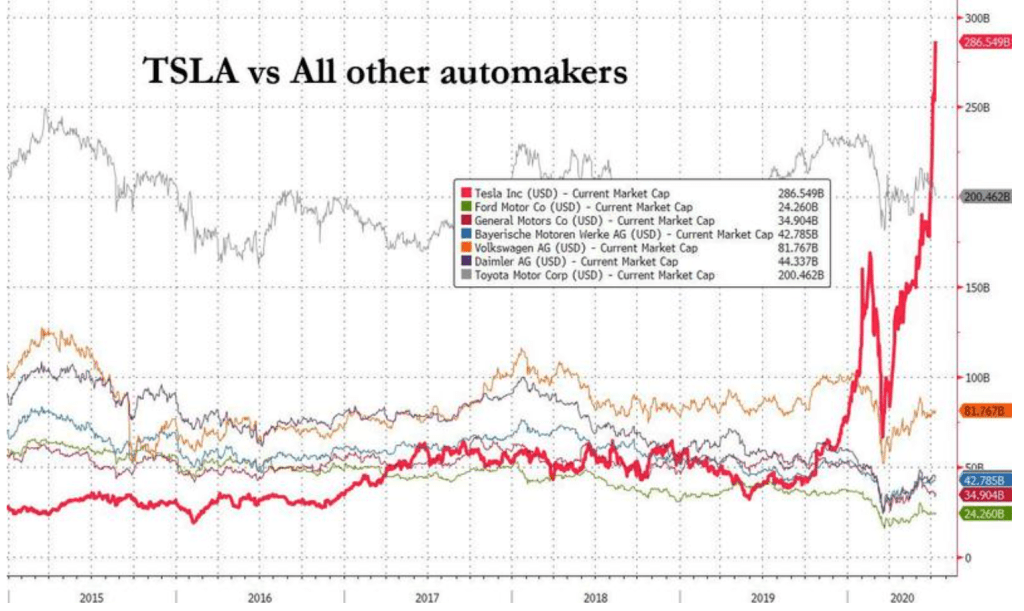
While so far Novogratz’ warnings have fallen on deaf ears, with Robinhooders clearly chasing momentum in such mega-bubble stocks as Tesla…whose market cap is now greater than that of Ford + GM +BMW + Daimler + Volkswagen combined…the man who made a killing buying bitcoin and ethereum ahead of the heard, said that the surge in equities, especiallly tech stocks, reminds him of the rally in Bitcoin prices in 2017, when the cryptocurrency went from $8,000 to almost $20,000 within a couple months due to retail interest…before crashing just as fast. It now trades at roughly half the price it reached during the December 2017 peak.

ZeroHedge, July 12, 2020
Source: ZeroHedge
Source: ZeroHedge
Source: ZeroHedge

Recession or Depression?

On June 24, the UCLA Anderson School of Management released its June quarterly UCLA Anderson Forecast on the outlook of the U.S. economy. This regularly scheduled release came after they revised their first quarter report for the first time in its 68-year history due to the shutdown of the economy as a result of the pandemic. And it sounds like the outlook for the U.S. economy just keeps getting worse.

Now, in its second quarterly forecast of 2020, the Forecast team states that the global health crisis has “morphed into a Depression-like crisis” and that it does not expect the national economy to return to its 2019 fourth-quarter peak until 2023

Press Release – UCLA Anderson Forecast, June 24, 2020

So let’s add this to the pile of evidence that the “V-shaped recover is just not going to happen. Their report had this to say about the U.S. economy:

“To call this a recession is a misnomer. We are forecasting a 42% annual rate of decline in real GDP for the current quarter, followed by a Nike swoosh’ recovery that won’t return the level of output to the prior fourth quarter of 2019 peak until early 2023,” writes the UCLA Anderson Forecast senior economist David Shulman in an essay titled “The Post-COVID Economy.”

“On a fourth-quarter-to-fourth-quarter basis, real GDP will decline by 8.6% in 2020 and then increase by 5.3% and 4.9% in 2021 and 2022, respectively,” he writes.

Shulman goes on to write that U.S. employment will not recover until “well past 2022” and that the unemployment rate, forecast to be about 10% in the fourth quarter of 2020, will still exceed 6% in the fourth quarter two years later. “For too many workers, the recession will linger on well past the official end date,” Shulman writes.

Shulman’s essay notes that the Federal Reserve acted with unusual alacrity by moving immediately to a near-zero interest rate policy and committing itself to supporting the corporate bond market, among other actions, and that the $1.8 trillion CARES Act moved quickly through Congress. He suggests that more relief will be needed this summer, and although a recovery is eventually forecast, it is expected to be moderate.

“Simply put, despite the Paycheck Protection Plan, too many small businesses will fail and millions of jobs in restaurants and personal service firms will disappear in the short run. We believe that even with the availability of a vaccine, it will take time for consumers to return to normal,” Shulman writes. He also states that the housing sector will be a lone bright spot in the recovery.

The forecast notes that while the economy seems to have hit bottom, it will take a while before GDP and employment levels reach fourth-quarter 2019 levels, as the huge debt buildup in both the public and private sectors dampen output. Looking beyond the forecast horizon of 2022, the pandemic has accelerated economic trends that were already moving toward increased digitization of business functions and online commerce.

“It has increased already-rising tensions with China and brought the E.U. closer together,” Shulman writes. “A major response to the pandemic has been the success of work-from-home, which looks like it will lead to long-term changes in the work and urban environments as workers avail themselves of more work/life options. In a nutshell, economic and housing activity will shift from large cities to mid-sized cities and away from the urban centers to the suburbs.

Press Release – UCLA Anderson Forecast, June 24, 2020

This article touches on an important point. As you start hearing about the economy recovering in the next few months, remember that this recovery’s starting point is at an extremely depressed level. Never has our global or national economy had an economic shock like we have just experienced. So if we see economic growth in the next few quarters around 5%, that sounds great, but remember we have likely just seen a 30%-40% decline in GDP. So it will take quite a few quarters of 5% growth to get back to where we were at the end of last year.

Conclusion: 2020 Versus 1929

So we have an economy in a severe, unprecedented recession (depression?), and a stock market, driven by a handful of tech stocks, sending the market back up near all-time highs. If you believe, as I do, that this market cannot remain this distorted long term, then the key question is when will it begin reflecting the conditions in the real world? That question is difficult to answer. There is a saying that the Fed can keep stock prices distorted longer than you can remain liquid, which is a warning about trying to time the big moves in the market. I learned long ago that it is a fools errand to try to exactly time market moves, but since I know where it is eventually headed, I can adjust my portfolio for the long term.

I finished reading a very good book about a month ago, Lords of Finance by Liaquat Ahamed. It follows the lives of the heads of the four key central banks (U.S., U.K., France and Germany) from the end of World War I through The Great Depression. This week, I went back and re-read Chapter 16, Into the Vortex, as I see a lot of similarities between today’s market and 1929, when that market bubble reached its peak. There are so many similarities between Davey Day Trader, and the “Robinhood” investors of today, and the numerous novice investors in 1929 who had that well-known Fear of Missing Out (FOMO) and invested in the market as it reached its peak.

The author starts the chapter with the following quote: “At particular times a great deal of stupid people have a great deal of stupid money…At intervals…the money of these people–the blind capital, as we call it, of the economy–is particularly large and craving; it seeks for someone to devour it, and there is a “plethora”; it finds someone, and there is “speculation”; it is devoured, and there is “panic.”–WALTER BAGEHOT

Let’s pull out a few excerpts from this chapter of the book, and see if you spot any similarities:

…while it was possible to predict the factors that caused any given stock to rise or fall, the overall market was driven by the ebb and flow of confidence, a force so intangible and elusive that it was not readily discernible to most people. There would be no better evidence of this than the stock market bubble of the late 1920s and the crash that would follow it.

The bubble began, like all such bubbles, with a conventional bull market, firmly rooted in economic reality and led by the growth of profits…

The first signs that other, more psychological, factors might be at play emerged in the middle of 1927 with the Fed easing after the Long Island meeting. The dynamic between market prices and earnings seemed to change. During the second half of the year, despite a weakening in profits, the Dow leaped from 150 to around 200, a rise of about 30 percent.

Lords of Finance

One big difference between past stock market bubbles and our current bubble is this one really didn’t start with a conventional bull market. Our current “bull” market has been driven by Fed liquidity, not economic reality. The big market distortions really started after the 2008 crisis, and growth since then has been very anemic.

It was in the early summer of 1928, with the Dow at around 200, that the market truly seemed to break free of its anchor to economic reality and began its flight into the outer reaches of make-believe…

That it was so obviously a bubble was apparent not simply from the fact that stock prices were now rising out of all proportion to the rise in corporate earnings–for while stock value were doubling, profits maintained their steady advance of 10 percent per year. The market displayed every classic symptom of mania: the progressive narrowing in the number of stocks going up, the nationwide fascination with the activities of Wall Street, the faddish invocations of a new era, the suspension of every conventional standard of financial rationality, and the rabble enlistment of an army of amateur and ill-informed speculators betting on the basis of rumors and tip sheets…

Trading stocks had become more than a national pastime–it had become a national obsession.

Lords of Finance

When I read “progressive narrowing in the number of stocks growing up,” I immediately remembered reading Sven’s article that discussed the big tech stocks, Microsoft, Amazon, Apple, Alphabet, and Facebook, being stocks that are driving this market higher. And what better way to describe Davey and the gang that a “rabble enlistment of an army of amateur and ill-informed speculators”? The similarities are almost scary! I am not sure I could describe todays environment as a national obsession, but it certainly is for a rather large segment of our population.

Anyone trying to throw doubt on the reality of this Promised Land found himself being attacked as if he had blasphemed about a religious faith or love of country.

As the crowd piling into the market grew, brokerage house offices more than doubled…These “board rooms” became substitutes for the bars shut down by Prohibition–the same swing doors, darkened windows, and smoke-filled rooms furnished with mahogany chairs and packed with all sorts of nondescript folk from every walk of life hanging around to follow the projected ticker tape flickering on the big screen at the front of the office.

Lords of Finance

So, an interesting parallel occurred to me when I read this today. In 1929, the brokerage houses became a substitute for the bars that had been closed due to Prohibition. And today, the stock market has become a substitute for sports gamblers who no longer have sports in which to bet on. I guess when our vices are taken away, we always find a replacement, but I had no idea how the stock market has taken the place of these vices on more than one occasion!

And you are attacked today if you criticize Davey and his crowd. Just ask Howard Marks.

The newspapers were full of articles about amateur investors who had made fortunes overnight.

The old crowd on Wall Street had a rule that a bull market was not in full stampede until it was being played by “bootblacks, household servants, and clerks.” By the spring of 1928, every type of person was opening a brokerage account–according to one contemporary account, “school teachers, seamstresses, barbers, machinists, necktie salesmen, gas fitters, motormen, family cooks, and lexicographers.” Bernard Baruch, the stock speculator who had settled down to a life of respectability as a presidential adviser, reminisced, “Taxi drivers told you what to buy. The shoeshine boy could give you a summary of the day’s financial news as he worked with rag and polish. An old beggar, hwo regularly patrolled the street in front of my office, now gave me tips–and I suppose spent the money, I and others gave him, in the market. My cook had a brokerage account.”

The stock pronouncements of shoeshine boys would become forever immortalized as the emblematic symbol of the excesses of that period. Most famously, Joseph Kennedy decided to sell completely out of the market when in July 1929, having already liquidated a large portion of his portfolio, he was accosted by a particularly enthusiastic shoeblack on a trip downtown to Wall Street, who insisted on feeding him some inside tips. “When the time comes that a shoeshine boy knows as much as I do about what is going on in the stock market,” concluded Kennedy, “it’s time for me to get out.”

Lords of Finance

And when an owner of a sports gambling website becomes the preeminent stock picker of 2020, maybe it’s time to move investments to the sideline and wait until the implosion clears.

The new folk heroes of the market were the pool operators, a band of professional speculators analogous to the hedge fund managers of today. They were typically outsiders, despised by the Wall Street establishment, who accumulated their fortunes–though they would soon enough lose them–by betting on stocks with their own and their friends’ money.

Lords of Finance

And the key phrase is “though they would soon enough lose them.” Market bubbles never end well. And unfortunately, it is typically those who are novices, trying for the first time to bet on the market, who lose out. I am hearing a lot that the market professionals are either sitting on the sidelines during the current market rally, or they are hedging their positions to protect their investments from a downside shock. And there is a reason they are doing this.

No doubt, with the Fed continuing to pump liquidity that finds its way into the markets, this rally could go on much longer than many believe possible. In many respects the stock market is driven by confidence, and right now most investors believe the Fed has their back and will provide support to the markets at any sign of a downturn. And so far they have been correct.

The challenge is understanding when you should get out. When does that confidence in the “Fed put” start waning? Who knows? But my strong advice is to trade carefully.

Markets and Economy Update – Laughing So Hard It Hertz

Greetings all, and happy Canada Day to all my Canadian friends, and an early happy Independence Day to my U.S. friends and family. Now that I have covered some background, let’s walk through the important developments in the past 1-2 weeks in regards to financial markets and the economy, which all tie in to our march further into the Fourth Turning

Financial Markets

What a roller coaster in the financial markets since late February. As the COVID-19 scare built, the financial markets took a big hit. Then, an incredible rebound occurred, starting in late March, pushing stocks back up close to, or in some cases, exceeding the all-time highs from February. Was this the shortest bear market in history? Not so fast. Beware of the potential for a classic “bull trap.”

The driver of the current stock market rebound has clearly been central bank policy and massive increased liquidity, led by our wonderful Federal Reserve Bank in the U.S. Before the COVID crisis hit, by almost any measure markets were overvalued. COVID was the pin prick that started the deflation of a financial asset bubble. However, central banks took quick action (much quicker and more aggressively than 2008), in effect re-inflating the market bubble. Their actions were quite breathtaking. It is no doubt that this has been the primary catalyst of the market rebound.

However, there is another phenomenon that is occurring that is pushing the U.S. stock market higher. Apparently driven by being stuck at home, bored, and nothing else to do, along with government stimulus checks and unemployment benefits (in fact, higher than some U.S. citizens take-home pay) providing some immediate cash with limited places to spend it, a new army of day traders have materialized, who have decided to “play” day trader to compensate for the lack of sports betting opportunities, led by DDTG (Davey Day Trader Global – https://twitter.com/stoolpresidente). In my opinion, this is classic market euphoria that has happened historically as markets are driven by extreme euphoria and FOMO (fear of missing out).

I read a lot in my spare time, and I recently finished a really good book, Lords of Finance by Liaquat Ahamed, that follows the story of the key central bankers who were the key financial leaders from World War I until the great depression hit. Our current day trading phenomenon reminded me of the market euphoria in the months leading up to the Great Depression. Back then, stock market investors were almost exclusively wealthy individuals. However, that changed in early 1929 as market euphoria took hold. The situation today seems very similar. And this time we have the Robinhood investing app and Davey Day Trader Global (DDTG) instead of the (quite tame in comparison) musings of Irving Fisher.

If you are not an intense sports fan, you may not know who DDTG (Dave Portnoy) is. He started a website that focuses on sports, betting, and other “bro” topics. And right before the pandemic hit, he sold 36% of his business, Barstool Sports, to Penn National, a casino company, for $163 million. Talk about great timing! And with no sports to talk about or gamble on, Mr. Portnoy decided to play the market with a portion of his windfall. In another stroke of luck, he started buying stocks right around the time that the market bottomed in March. With his mantra of “stocks only go up,” and being right SO FAR, he has proceeded to call out investing icons such as Warren Buffett (he’s “washed up…I’m a better stock picker than he is now”), Howard Marks and others. Of course, this is all to entertain his fans when there are no sports to discuss, but it does remind me of stories that were documented in the lead-up to the crash of 1929.

And many of DDTG’s followers are new investors, also sitting at home with no sports to bet on, that have signed up to use Robinhood to invest. Robinhood is a new online stock app where you can invest in the markets with no fee for buying or selling. It is the new hot app for the young crowd that have started investing for the first time. If you are one of these new investors, no offense, but you may want to study some Financial Markets 101 before you start investing your money. As proof of the absurdity of the markets, let’s revisit the Hertz bankruptcy that I covered a few weeks ago. As a reminder, Hertz filed bankruptcy on May 22. Let’s now look at the chart below from www.robintrack.net, a website that tracks Robinhood investor activity.

The green line is the number of Robinhood accounts that own Hertz stock, and the pink line is the share price. If you look at the far right of the graph, you will see activity leading up to and folllowing Hertz’s bankruptcy as our novice investors poured into the stock.

Date# Robinhood InvestorsStock Price
February 20, 20201,064$20.29
May 22, 202044,297$2.84
May 25, 202044,354$0.65
June 5, 202094,993$5.53
June 15, 2020170,814$2.83
Robinhood users ownership of Hertz (HTZ)

As you can see, post-bankruptcy our new market participants drove the share price up from $0.65 at the time of bankruptcy to $5.53 almost two weeks later! That’s a 751% increase in the stock price! For a bankrupt company!!!! For new market participants, here is some advice: you may not want to invest your money in stocks where the company has filed bankruptcy. Why? When a company files bankruptcy, they have typically run out of cash and cannot get any further financing. Their liabilities are greater than their assets. The credit risk is so high, no one will lend to them. They may be able to restructure, sell assets, and continue to survive.

However, shareholders almost always get NOTHING! Zero. Nada. Zilch. They are the last in line to get anything of value in a bankruptcy. The holders of debt and other liabilities will get some compensation (usually much lower than what is owed), but not shareholders. If the company survives, it will typically issue new shares to new shareholders (in many cases a form of compensation to lenders), but existing shareholders prior to bankruptcy will never recover any of their investment. So our new breed of day traders must have assumed that since Hertz is a company with a very long history, it must be a great investment to get in at less than a dollar! Oops.

So the signs of market euphoria are everywhere. I am reading that the “smart money,” or professional investors, are sitting on the sidelines during this market rally. Why? Because the disconnect between the market and the underlying economy are at extreme levels, and as mentioned before, at historically high valuations. There is some small chance the market can stay elevated at these levels, driven by the massive liquidity provided by the Fed, but I believe it is much more likely that another drop will come soon, regardless of central bank actions that drive up markets.

One of my favorite reads is the bi-weekly newsletter Things that make you go hmmm by Grant Williams. In his most recent edition (June 21), titled Inconceivable, he covers some of the crazy things going on in the markets right now including Robinhood and DDTG.

Lord knows, in recent years, I’ve found myself uttering [Inconceivable!] on countless occasions but, since the beginning of this month, events have taken a turn for the preposterous…

Things that make you go hmmm, June 21, 2020

That was his introduction, and afterwards he covered the Hertz situation in detail as well as other similar situations. In reference to the new group of day traders, he comments as follows:

These people aren’t here for a long time, they’re here for a good time (although, lately, they’ve been having such a good time that, who knows? Maybe they’ll stick around a bit longer).

Things that make you go hmmm, June 21, 2020

We have certainly seen a bit of a pullback in the last week, which by no coincidence occurred at the same time as the Fed’s balance sheet started to contract a bit. I fully expect a lot of volatility for some period of time, with wild swings up and down. Trade carefully!

The Economy

The recession that we are now in is unlike previous recessions. Usually, recessions are triggered by an event in the financial markets, such as the dot com bubble in 2000 or the mortgage market collapse in 2007-2008, which then affects the economy. This time, it was the economy experiencing an extreme shock because of the virus hitting, causing businesses to shut down, resulting in a demand shock. This was after experiencing a supply shock when China, the world’s factory, shut down. It has created a chaotic situation for many businesses. The unemployment numbers are shocking, like nothing before with the speed in which it happened.

I read two different articles discussing this in the past few days (both are free newsletters). The first is Thoughts from the Frontline by John Mauldin, whose June 26 newsletter was titled “A Recession Like No Other.” Here are a few key points I gleaned from his analysis of the “Corona Recession,” with reference to recent published remarks from economist Woody Brock.

I thought we were headed for a credit crisis, centered on corporate debt rather than mortgages, as happened in 2008. The Fed’s decades-long easy money policies have many businesses leveraged to the hilt. That remains the case and could still become a bigger problem but for now, we are in something unique: a supply-and-demand-driven recession. Specifically, service supply dried up almost overnight as people lost those service jobs and, as will see, those with more money started to save dramatically more, further reducing demand.

Normally, some kind of trigger or “shock” makes business activity contract. Tighter credit or higher interest rates are often the culprit, not simply falling sales. Unable to finance continued operations, businesses close and lay off workers, who then reduce their consumption. The effects cascade through the economy and recession begins.

This time, the shock came with the coronavirus and our reaction to it. Note, it wasn’t just government-ordered shutdowns. Data now shows consumer spending started failing weeks before governors acted. Retail service businesses saw store traffic falling and, with risks to employees and customers rising, many closed even when not required to. But the result was the same: Business activity contracted and triggered a recession.

John Mauldin, Thoughts From the Frontline, June 26

I then read Bill Blain’s The Morning Porridge June 29 edition, titled “What if it’s just begun?”

This crisis is unlike anything I’ve experienced before. Normally a market crash is [an] explosive event – it occurs when something in the financial sphere breaks; like confidence in housing and financial systems in 2007, or valuations in the Dot.Com crash, or faith in credit constructs like during the European Sovereign Debt crisis in the 2010s. In each case of financial mayhem I’ve experienced since the Great Perp Crash of 1986, the initial shock and horror gradually lessens as the market discounts the shock, shrugs it off, and carries on…

This time it feels different. The crisis started off with a meteor strike – the virus. We’ve never seen anything impact the real economy so dramatically. Normally – it happens the other way around: financial crashes impact the markets and only then does the pain trickle down into the real world. This time it’s real jobs and production that got hit first. That’s fundamentally different.

I’m not convinced that markets really understand that difference. The effect on the real economy of financial failure is felt in terms of the flow of capital to businesses. If a bank blows up – it will impact savers and borrowers. This time we’re looking at how will crashing earnings and diminished rental incomes hit the financial markets – but they are behaving as if it’s just another round of QE [quantitative easing] Infinity for the markets to arbitrage. As we all know markets are completely delinked to the real world at present.

Yet, the damage the real world is going to inflict on financial markets is going to be huge – but that’s not what I see the banking regulators and authorities preparing for. They’re pushing financial institutions to participate by easing lending and supporting confidence. You can understand why – yet they also know a crisis [is] coming. Just read the dissenting statement by Fed Governor Lael Brainard after she stepped back from the Fed’s decision to allow bank dividends: “many large banks are likely to need greater loss absorbing capital to avoid breaching their buffers in adverse circumstances nest year.”

The bottom line is global central banks know a financial crisis is possible/probable.

Bill Blain, The Morning Porridge, June 29

So this time is really different, and not in a good way. Our central bankers, already incompetent in so many things, appear to be “flying blind” in our current situation. I fear we are beginning to see the last few snowflakes that will eventually start an avalanche of actions that will drive negative consequences for the economy. There are so many companies that have increased debt on their balance sheets, driven by cheap money. And in too many cases, they have used this cash to buy back stocks, increasing their executive bonuses at the expense of adding financial risk to their company. I do not see this ending well.

Bankruptcies continue to pile up. Chesapeake Energy, a company that pioneered fracking to extract natural gas, was the latest headline casualty. Also added to the list are Whiting Petroleum, Cirque de Soleil, Aeromexico and Chuck E. Cheese. We have now had 17 major retailers file for bankruptcy so far this year, including GNC, Roots USA, Tuesday Morning, True Religion, Centric Brands, Modell’s Sporting Goods, J.C. Penney, Art Van Furniture, Stage Stores, Bluestream Brands, Aldo, Pier 1, Neiman Marcus, SFP Franchiees Corp., and J Crew. Here in Canada where I now live, several well-known retailers have filed, including Reitman’s, Sail, and Aldo. I am confident the list will continue to grow. Many of these companies will survive, but with fewer stores and fewer employees. And this is on top of last year’s retail bankruptcies that resulted in over 9,500 stores closing. This year will be worse.

As far as who could be next, keep an eye on Michaels, Carter’s, Tailored Brands, Game Stop, Designer Brands International, Bed Bath & Beyond, and Ascena. There are also a lot of restaurants at risk, especially those that rely on the dine-in segment. And if a large number of retailers file for bankruptcy, who gets impacted? First in line, the owners of the shopping centers where these stores are located.

So next you should keep an eye on retail Real Estate Investment Trusts (REITs), especially those with a lot of debt. If tenants are not paying rent, and leases get discharged in bankruptcy resulting in vacant units, this will inevitably lead to the owners of that real estate having financial difficulties. The avalanche starts picking up steam. Travel-related industries are also being hit hard. The CEO of Air BNB even said this week that the travel industry will never get back to “normal,” referring to pre-COVID-19 conditions.

I ran across a good article about the impact on retail and shopping centers this week. There are so many small independent retailers and restaurants that will not make it through this crisis.

In short, bricks and mortar retail has been caught in a pincer movement, flanked on one side by Covid-19 itself, and on the other site by its cure. You know this already: The virus separated us, the cure institutionalized that separation, forcing societal shutdown that has driven us into our deepest recession in perhaps living memory, a recession that seems certain to run several years. The coronavirus means we will remain wary of one another until there’s a vaccine, perhaps longer; the cure means a majority of Americans will have little to spend.

What does this portend? Putting aside kids swarming the beach towns, few of us wish to take more risks than necessary. Driving on a freeway entails infinitesimal risk, but we do it to get somewhere; going shopping now involves a minute risk, but we accept it if the shopping is essential…

Our essential retailers – supermarkets, drug stores, banks, convenience stores and gas stations – are doing fine; in fact groceries and gas are killing it. Someone’s idea of essential, liquor stores and cigarette shops, are not complaining either…

Personal services – beauty shops, nail salons, dry cleaners, massage parlors, yoga studios and gyms, etc. – win on cheap, but lose on distancing. Fortunately for some – notably, hair and nails – essential trumps distancing; these shops will come back swiftly. Others, like dry-cleaning and massage, are less essential and will take time to regain their pre-Covid levels.

Finally, there’s the sweat subcategory: small gyms, bike spinning parlors, yoga studios, etc. Absent an amazing vaccine, these tenants may be in serious trouble. You can’t make money at 50 percent maximum capacity and you’ll never convince some meaningful percentage of your customers that they’ll be safe dodging sweat in a tightly packed room.

Following the distancing/cheap lodestone, food shapes up like this: drive-throughs are golden, traditional take-out (e.g. pizza) is rocking, and those restaurants that can successfully ramp up their take-out should be fine.

By the way, the coronavirus didn’t create retail’s larger problem – excess capacity – it merely pulled its curtain back. According to Forbes, we have roughly 50 square feet of retail space per capita in the USA while Europe has just 2.5 square feet. Washington DC has a restaurant for every 103 residents, while San Francisco has one for every 201 residents. That’s a lot of competition…

Bringing this home: To date, we’ve permanently lost half-dozen retailers, from restaurants to clothing to massage. Tenants who in effect said sue me, I’m taking a hike. To compound this unpleasantness, it would be fair to say that replacement shop tenants are just behind the spotted owls on the endangered species list. But if there is a safe harbor in retail, it’s a supermarket center in a good residential neighborhood. Without plan or compass, we happened to bob into that harbor years ago.

John E. McNellis, Principal at McNellis Partners, via Wolf Street (h/t ZeroHedge)

That is a great summary by a retail shopping center owner. Enclosed malls are the clear loser so far in this crisis, with open-air power centers and neighborhood centers anchored by a food retailer being best positioned to weather the storm. As difficult as the past three months have been for the retail and travel industries, another disruption with infections ramping up in the south and west in the U.S. is a problem. I believe there will be a collapse in these industries if a significant portion of the U.S. goes into a lockdown again. It will be brutal.

Shockingly, there are still economists that are predicting a quick “V-shaped” (i.e. rebound by year end) economic recovery. Seriously, what are they smoking? UCLA Anderson and senior economist David Shulman have updated their second quarterly economic forecast, with some interesting tidbits.

…the virus pandemic has ‘morphed into a Depression-like crisis’ with no V-shaped recovery until 2023.

‘To call this crisis a recession is a misnomer. We are forecasting a 42% annual rate of decline in real GDP for the current quarter, followed by a ‘Nike swoosh’ recovery that won’t return the level of output to the prior fourth quarter of 2019 peak until early 2023′ Shulman writes in a report titled “The Post-COVID Economy.”

“Simply put, depsite the Paycheck Protection Program, too many small businesses will fail and millions of jobs in restaurants and personal service firms will disappear in the short run. We believe that even with the availability of a vaccine, it will take time for consumers to return to normal” Shulman writes.

Zero Hedge, “;Depression-Like Crisis’ Unfolding With No V-Shaped Recover Until 2020, UCLA Anderson Warns”, June 25

That is not encouraging at all.

So, who holds the debt of these companies that are filing or are at risk of filing for bankruptcy? Banks, pension funds, sovereign wealth funds, insurance companies, etc. hold most of this debt. And with unemployment continuing to grow, and the extra federal subsidies for unemployed workers set to expire in a few weeks, it is difficult to see how consumer spending will get back to the levels before the coronavirus hit.

Chris Whalen of The Institutional Risk Analyst had some interesting insights on the commercial real estate environment.

So how big is the impending commercial real estate bust in the US? Bigger than the residential mortgage bust of the 2000s and also bigger than the commercial real estate wipeout of the 1990s, including the aftermath of the Texas oil boom of the late 1970s and 1980s…

The latest Mortgage Bankers Association survey shows that commercial banks continue to hold the largest share (39 percent) of commercial/multifamily mortgages of $1.4 trillion. Agency and GSE [Government Sponsored Enterprise] portfolios and MBS [Mortgage Backed Securities] are the second largest holders of commercial/multifamily mortgages, at $744 billion (20 percent of the total). Life insurance companies hold $561 billion (15 percent), and CMBS [Commercial Mortgage Backed Securities] and other ABS [Asset-Backed Securities] issues hold $504 billion (14 percent)…

The fact of the COVID19 lockdown, the riots and looting following the killing of George Floyd by the Minneapolis police, and the coincident rise of telecommuting, which keeps people away from the large metros, raises questions about the entire economic structure of cities. So long as social distancing is required or even the preferred option, many of the institutions and structures within the big cities no longer function.

Connor Dougherty and Peter Eavis reported in the New York times on Friday: “Faced with plunging sales that have already led to tens of millions of layoffs, companies are trying to renegotiate their office and retail leases – and in some cases refusing to pay – in hopes of lowering their overhead and surviving the worst economic downturn since the Great Depression. This has given rise to fierce negotiations with building owners, who are trying to hold the line on rents for fear that rising vacancies and falling revenues could threaten their own survival…”

So how big will the commercial real estate bust be in 2020-21 and beyond? In 1991, the FDIC reports, “the proportion of commercial real estate loans that were nonperforming or foreclosed stood at 8.2 percent, and the following year net charge-offs for commercial real estate loans peaked at 2.1 percent.”

In 1991, the net charge off rate for all $1.6 trillion in bank owned real estate loans was less than 0.5%. Multifamily mortgage loans peaked in Q4 of 1991 around 1.5% of net charge offs but remained elevated until 1996.

But this time is different. Based on our informal survey of REIT valuations and individual assets, we think that the world has been turned upside down for many investors. Actual LTVs [Loan-to-value ratios] for urban commercial and luxury residential assets in many metros are well-over 100 and are likely to be restructured, albeit over a period of years. As we noted last week, it’s all about buying time.

We think that net charge offs on commercial loans could rise to 2-3x the peaks of the 1990s, with loss rates at 100% or more in some cases, and remain elevated for years to come as the workout process proceeds.

Failing some miraculous economic rebound in the major metros, look for credit costs related to commercial real estate climb for REITs, CMBS investors, the GSEs, and banks in that order of severity. Figure a 10% loss spread across $5 trillion of AUM [Assets Under Management] over five years?

Chris Whalen, The Institutional Risk Analyst, H/T ZeroHedge, June 8

If I can summarize, a “V-shaped” recovery is pipe dream. The dominoes are already starting to fall. Many of the job losses to date will likely move from temporary to permanent. Our economy is no longer driven by manufacturing, as it today is primarily a service economy. And when many service industries, such as retail, restaurants, and travel, have suffered the brunt of COVID-19, a significant portion of our economy is suffering.

Conclusion

I originally planned to also cover some geopolitical events in this post, but my ramblings on the financial markets and the economy were quite a bit longer than I anticipated. So I will cover some geopolitical events from the past few weeks in my next posting (hopefully this weekend).

Our economy has taken a gut-punch, and we are staggering. Unfortunately, I do not believe the Fed’s actions are the cure for what ails us. As I covered above, this shock to our economy and financial markets is unique. And our ability to recover from this is negatively impacted by the central bank’s actions over the past 20-30 years to “kick the can down the road.” At some point, we will reach the end of the road, with nowhere to go other than off the cliff that is dead-ahead.

We find ourselves in the midst of our Fourth Turning crisis, with no easy way out. The next few years will be hard, very hard. But I still believe in American Exceptionalism. We will come out of this stronger than before. We have no choice but to “hunker down’ and face the challenges full-steam ahead. But the silent majority in our country must stop the silence, and be heard. Otherwise, we will lose all those attributes that have made us exceptional. And we need true leadership! I have yet to see any real leaders in our government step up to give me confidence that we have leadership in our country that can maneuver us through this crisis. We are not a country of chaos and disunity. Although if you viewed the current events of the past few months, it doesn’t seem to be the case.

I have spent the majority of my career in the real estate industry, and I find myself in the middle of the current economic storm. I am just very thankful that I am employed by a company that has taken a conservative financial approach to managing their business, with a strong balance sheet that can survive when others become insolvent. I am also very thankful that I have a job where I can effectively work remotely from home. I know many others who do not have that option.

Let’s prepare ourselves for the challenges ahead. I hate to say it, but I doubt we will ever go back to the good times we had just a few short months ago. I have heard many speak of the “new normal,” and I think that is absolutely correct. Change is hard. And we all now face a multitude of changes in our life. Economic. Social. Geopolitical. One of my favorite quotes, from a Kellly Clarkson song, is, “What doesn’t kill you makes you stronger.” Let’s all persevere, and come out stronger on the other side of this Fourth Turning. If you have no idea what I am talking about when I reference the Fourth Turning, go check out my post on the subject. Check out The Fourth Turning website (https://www.fourthturning.com/). And read the book. I know some of you have already done that.

Happy Canada Day and Independence Day (and Happy Summer to all others),

Brent

Mistaken Macroeconomic Policies, Part 1

According to the common narrative after the Global Financial Crisis, the world’s leading central banks were the heroes that saved the day. And more recently, the central banks, especially the U.S. Federal Reserve, once again rescued the credit markets this year as the Pandemic unfolded. However, what if I told you that many economists believe these crises were actually a result of previous central bank missteps?

Stability breeds instability.

Hyman Minsky, American Economist

Introduction to Central Banks and Debt Cycles

I know many may not be familiar with the role of a central bank, so let’s start with a definition:

A central bank is a financial institution given privileged control over the production and distribution of money and credit for a nation or a group of nations. In modern economies, the central bank is usually responsible for the formulation of monetary policy and the regulation of member banks.

https://www.investopedia.com/terms/c/centralbank.asp

In simple terms, a central bank manages the money supply for a country or countries and sets interest rates (i.e. the cost of money) and controls the amount of currency in circulation. The most influential central banks are the U.S. Federal Reserve (the Fed), European Central Bank (ECB), Bank of Japan (BOJ), Bank of England (BOE), Bank of Canada, Royal Bank of Australia (RBA), and People’s Bank of China (PBOC).

In this article, I will primarily focus on the Fed, although in many cases these issues are prevalent in most of the above-mentioned central banks.

Throughout the history of central banks, their primary mission has been price stability. In other words, central banks take actions to control inflation to keep all of the consumer goods that citizens purchase at a stable price. An economy will tend to move between periods of growth (i.e. booms) and contraction (i.e. busts). Periods of growth will start at the bottom of the business cycle, where central banks have lowered interest rates in an attempt to stimulate the economy. At the bottom of the cycle it becomes easier and cheaper for businesses and individuals to get loans. These loans are then used to reinvest in businesses and increase production. As this cycle continues and more currency is injected into the market, this creates greater demand for products and services. As this happens, prices begin to increase in response to the greater demand.

For example, in 2001, after the dotcom bust, the Fed lowered rates and provided additional liquidity to stimulate the economy. As this progressed, mortgage rates dropped lower than had ever been seen before. This stimulated demand for more houses as affordability increased, resulting in higher and higher home prices. This is an example of how greater liquidity results in inflation.

As this process occurs, and the economy gets “overheated,” and inflation rises, the central banks then start increasing interest rates to get inflation under control. However, as rates rise, the weaker companies that could survive with rates low can no longer service their debt payments at these higher interest rates, causing bankruptcies of those weaker companies. This process of the “survival of the fittest” in relation to businesses is what Joseph Schumpeter coined as “creative destruction.”

Joseph Schumpeter

(1883-1950) coined the seemingly paradoxical term “creative destruction,” and generations of economists have adopted it as a shorthand description of the free market’s messy way of delivering progress.

https://www.econlib.org/library/Enc/CreativeDestruction.html

As businesses fail, employees get laid off, resulting in a recession, where the economy contracts. This is the “bust” portion of the business cycle. When this occurs, the central bank will begin lowering rates in order to stimulate the economy back into a new growth phase.

This is the classic free market business cycle, which is probably more accurately described as a credit cycle, due to the influence of the central bank on this cycle through monetary policy.

One of the more interesting reads, if you want to dig into this topic further, is a book, Big Debt Crises, by Ray Dalio, the founder of Bridgewater Associates, one of the largest hedge funds in the world. You can download a PDF version of the book for free at https://www.principles.com/big-debt-crises/. Ray has studied past cycles, and he has identified a pattern of small debt cycles every 7-10 years that culminate in a super debt cycle ever 70-80 years. And for those of you who read my most recent post, this research ties really well with The Fourth Turning. The last debt supercycle resulted in the Great Depression, and Ray predicts we are approaching the end of the next supercycle as we reach the climax of the next Fourth Turning.

The graph below shows how this current debt supercycle has grown. The amount of debt in the economy continues to grow from cycle to cycle, until it becomes so large that it is ultimately unsustainable.

Where the Fed and Other Central Banks Have Erred

So how has the Fed erred in monetary policy? I think the cause is actually quite simple. In 1978, the Fed was given an additional mandate, in addition to the mandate on price stability: maintain full employment.

Since its creation in 1913, the Federal Reserve and its monetary policies have had a substantial impact on overall economic conditions and the labor market. With the passage of the 1978 Full Employment and Balanced Growth Act (also referred to the Humphrey-Hawkins Act), the Federal Reserve was specifically required to “promote full employment and production, increased real income, balanced growth…adequate productivity growth, proper attention to national priorities, achievement of an improved trade balance […] and reasonable price stability.”

https://cepr.net/images/stories/reports/full-employment-mandate-2017-07.pdf, page 1

However, when you consider this mandate in relation to the business cycle outlined above, to avoid unemployment you must avoid raising interest rates so as to avoid recessions. This is at odds with the price stability mandate, as any action to control inflation by raising rates will tend to result in and increase in unemployment.

Initially after the bill’s passage, the primary focus remained price stability.

For decades after the “Great Inflation” of the 1970’s, economists and Federal Reserve officials prioritized price stability, and even viewed full employment through the lens of what was possible to prevent inflation.

https://cepr.net/images/stories/reports/full-employment-mandate-2017-07.pdf, page 13

This changed, however, in the 1990s under Fed chairman Alan Greenspan (1987-2006), who believed it was possible to keep rates low and maximize employment while keeping inflation in check. And throughout the 1990s, it worked. The economy hummed along at its best pace in 30 years, with low unemployment and inflation under control.

Unintended Consequences

However, under the surface, some unintended consequences were taking place, primarily a building asset bubble in technology stocks. This occurred due to an economy that was flush with cash, leading to increased investments in the stock market. And of course the hottest stocks were the new high-tech sector. It didn’t matter if these companies were profitable or generated positive cash flows, and the valuations became extreme, especially for an accountant like me that understood how to read a company’s financial statements. Some of you may remember these companies that crashed down to earth: Priceline.com, Webvan, TheGlobe.com, Pets.com, eToys.com, and Drkoop.com are a few examples. Even the companies that survived the crash experienced substantial drops in their valuations when the bubble eventually burst.

Low interest rates also encourage people and companies to borrow more money, in effect bringing spending forward. Let’s re-visit the graph above, and look at how debt grew after the Fed’s new mandate in 1978.

The policy of the central bank to continually step in, lower interest rates, and encourage companies and people to take on more debt has been in place since the 1930s. The idea that the central bank could push interest rates down and make more credit available to smooth out the business cycle is designed to have an economy that operates with fewer recessions, less severe recessions, and ultimately longer periods of expansion. This policy worked, but it also created the Great Debt Supercycle: Every time we get ourselves in a recession, the total debt of the U.S. economy rises relative to gross domestic product (GDP) to new and higher levels. This is not sustainable in the long run, even if we are able to push interest rates into significantly negative positions on a sustained basis.

Guggenheim Global CIO Outlook, May 10, 2020

Another unintended consequence is that these policies can artificially inflate financial assets like stocks and bonds. Who does this benefit? The rich. The top 1% richest individuals now own more that 50% of corporate stocks, and the top 10% own 88%!

https://business.financialpost.com/investing/how-americas-1-came-to-dominate-stock-ownership

So when the financial markets are artificially inflated by Federal Reserve policies, it is the rich that benefit. This is a key reason why today we have extreme wealth inequality in the United States. Take a look at this graph, and you will see that wealth inequality started increasing as The Fed’s looser monetary policies began to be implemented in the early 1990s. Even after the market declines in 2001 and 2009, the trend quickly re-accelerated.

Of course, this is not intentional.

Oh, so maybe I am wrong about that “unintentional” thing. Sorry about that.

We are now in an era where many central banks are keeping interest rates artificially low in order to avoid recessions. It all started with the Bank of Japan, where they were successful in keeping rates low without creating high inflation. However, growth has stagnated in Japan for the past 30 years. This is the path that many other central banks are now going. But keeping rates artificially low also has negative consequences. It punishes savers, especially older people on fixed incomes. The returns on safe investments such as government bonds no longer provide much of a return. The alternative is to put your investments in riskier assets in an effort to boost returns. Unfortunately, this reach for yield can end in disaster if the underlying value of these assets drop.

In addition, as debt loads increase at the government, corporate, and individual levels, growth stagnates. It is a proven mathematical fact that the Fed’s actions to drop rates are resulting in less and less effectiveness as debt loads increase.

If I wanted to think of how to destroy a country, I could not have done a better job if I’d tried. Years of zero interest rate policy (ZIRP) and quantitative easing (QE) created the most inequality we have ever experienced. Then everyone is locked up for a few months, and all it takes is a spark…

I don’t spend much time criticizing the Fed. (There are enough people who have made entire careers out of that.) And it may seem like a bit of a stretch to blame the riots on the QE of 2008, but I disagree.

Monetary policy indirectly bears responsibility here. If you wanted to fix all of this overnight, it is actually very easy: Raise interest rates to 5%.

Jared Dillian, “The 10th Man – The Saddest Day Ever”, June 4, 2020 https://www.mauldineconomics.com/the-10th-man/the-saddest-day-ever

Conclusion, Part 1

We are heading for the end of a debt supercycle, which will likely end in a painful deleveraging. Has the recent pandemic led to the start of this? It is very possible, but the central banks may be able to “save us” again by “kicking this debt can down the road” for a few more years. Time will tell. Remember, the last debt supercycle resulted in the Great Depression, and debt loads as a percentage of economic output (i.e. GDP) are higher this time. As an aside, I am now reading a book, Lords of Finance, that follows the lives of the heads of the central banks of the U.S., U.K., France and Germany from the 1920s through the Great Depression. The good news is that central banks have discovered more “tools” since then to seemingly avoid a major crisis. However, the debt load continues to grow, with a huge spike in debt as a result of the economic collapse brought on by the pandemic. One of these days the party will end. The only question is when this will happen.

Thanks to all who are reading my musings. I am thrilled to report that after only a couple of weeks I have readers across the globe, including the U.S., Canada, Hong Kong SAR, China, Costa Rica, Brazil, Argentina, Germany, Czech Republic, and India. I am honored that you find these posts of interest.

As a follow-up to last week’s post on The Fourth Turning, I failed to include a link of a one hour interview with Neil Howe that is free at https://ttmygh.com/hmmminars/. The interview with Neil is #16, right at the top. You may want to check out some of the other interviews as well, with top leaders in financial markets, economics, and geopolitics. This website’s author is Grant Williams, who writes an incredible newsletter (bi-weekly, 25 issues per year). I first came across Grant’s writings about 5-6 years ago, when access to his site was free. Grant later made it a paid newsletter, and I must admit I am financially conservative (a nice way to say I’m cheap), so I initially resisted paying for a newsletter that was previously free. However, after about a year, I missed it so much that I subscribed and then read all of the issues I had missed! It is well worth the money if you want another source of material for understanding financial markets and the economy.

I hope everyone has a great week!

Best Regards,

Brent

The Fourth Turning

I must admit that last night I was saddened to see the protests that are turning violent across the U.S. I get the anger, and I am all for peaceful protests, but I must admit I don’t like seeing the violence and destruction that is taking place. I am sure many of us are confused about what is happening in the world, from Hong Kong to France to Chili, etc. in the past 12 months. And then layer on the pandemic and resulting economic collapse, and the world just doesn’t seem right. Welcome to the Fourth Turning

As I moved through my journey to better understand the economy and markets starting in 2011, I came across a book that made me understand better the societal shifts and we move through different time periods. This understanding started when I heard Neil Howe speak at an investment conference about The Fourth Turning, a book that he co-wrote with William Strauss that was published in 1997. After hearing Neil speak, I immediately purchased the book to learn more.

So a little background on Neil. He is a historical economist with an undergraduate degree in English literature from U.C. Berkeley, and advanced degrees in economics and history from Yale University. In the 1990’s, he and William Strauss (now deceased) began studying social generations in history. Their first book, Generations, reflected the beginning of this work.

Based on their study of history, they noticed a defined pattern in society, where there are four types of generations that recur over time in a cycle. As I came to better understand Neil’s work, I realized that all of human life is in cycles. We have monthly cycles, seasons of the year, business cycles, etc. I encourage you to visit The Fourth Turning website, wwww.fourthturning.com to learn more. The website contains basic information from the book to understand generations, generational archetypes, and the four turnings. Below is an introduction in turnings from the website:

History creates generations, and generations create history. This symbiosis between life and time explains why, if one is seasonal, the other must be. If generational archetypes repeat in a fourfold cycle, this implies a recurrence of social moods or eras that form these archetypes sequentially.

This is precisely what Strauss and Howe discovered as they investigated generations in American history: Over the past five centuries, Anglo-American society has traversed a four-stage cycle of social moods or eras. At the start of each era–or “turning” as the authors call them–people change how they feel about themselves, the culture, the nation, and the future. Each turning tends to last about twenty years: roughly the span of a generation, and the amount of time it takes to pass through one entire phase of human life. The Romans named this length of time the saeculum, meaning both “a long human life” and “a natural century.”…

lifecourse.com/about//turnings-introduction.html

The length of the four turnings are about 70-90 years, approximately the length of a long human life. These four periods each have a distinctive characteristic, as follows:

First Turning

The First Turning is a High…This is an era when institutions are strong and individualism is weak. Society is confident about where it wants to go collectively, even if those outside the majoritarian center feel stifled by the conformity. Americas most recent First Turning was the post-World War II American High, beginning in 1946 and ending with the assassination of John Kennedy in 1963…

Second Turning

The Second Turning is an Awakening…This is an era where institutions are attacked in the name of personal and spiritual autonomy. Just when society is reaching its high tide of public progress, people suddenly tire of social discipline and want to recapture a sense of personal authority. Young activists and spiritualists look back at the previous High as an era of cultural poverty. America’s most recent Awakening was the “Consciousness Revolution,” which spanned from the campus and inner-city revolts of the mid-1960s to the tax revolts of the early ’80s…

Third Turning

The Third Turning is an Unraveling…The mood of this era is in many ways the opposite of a High. Institutions are weak and distrusted, while individualism is strong and flourishing. Highs follow Crises, which teach the lesson that society must coalesce and build. Unravelings follow Awakenings, which teach the lesson that society must atomize and enjoy. America’s most recent Unraveling was the Long Boom and Culture Wars, beginning in the early 1980s and probably ending in 2008…

Fourth Turning

The Fourth Turning is a Crisis…This is an era in which America’s institutional life is torn down and rebuilt from the ground up–always in response to a perceived threat to the nation’s very survival. Civic authority revives, cultural expression finds a community purpose, and people begin to locate themselves as members of a larger group. In every instance, Fourth Turnings have eventually become new “founding moments” in America’s history, refreshing and redefining the national identity. America’s most recent Fourth Turning began with the stock market crash of 1929 and climaxed with World War II…

https://www.lifecourse.com/about/method/the-four-turnings.html

So, if you believe the work of these two gentlemen, the reason for chaos in the world right now is due to being in the middle of the most recent Fourth Turning, starting with the Global Financial Crisis in 2008, and likely culminating by the end of the decade of the 2020s. By the way, in the book they predicted the rise of populism, nationalism, and the emergence of leaders like Donald Trump, Jair Bolsonaro in Brazil, Andres Manuel Lopez Obrador in Mexico, Janos Ader in Hungary, Xi Jinping in China, and many others already in power or soon to come in the middle of this turning. We have had a couple of years of trade wars between the U.S. and China (and others), and in no way has that been settled. I believe the pandemic has just quickened what was already coming in the next few years.

Of course, my writings are on economics, so let’s review the current fourth turning from an economic standpoint. It all started with the financial crisis in 2008, which was triggered by a bubble in the U.S. housing market. We came very close to an even worse financial crisis as the credit markets froze. You know when large, strong companies like Walmart suddenly cannot access the short-term credit market, there is a big problem. I believe 2008 also uncovered some companies that had too much debt, such as General Motors and the large U.S. banks. The banks then had to be bailed out due in part to risky investments that went bad as the market fell. The Federal Reserve saved the day with the first round of quantitative easing (QE1). In a later post, I will cover the subsequent central bank mistakes that have left us now in another perilous situation, both in the U.S. and many other markets.

I am confident we have not solved our financial problems across the globe, and there will be more financial turmoil to come. Remember, the Great Depression occurred during the last Fourth Turning, and the amount of global debt will be a problem at some point in the next ten years.

According to Mr Howe, a Fourth Turning does not necessarily have to climax with a significant war, but in many cases they do. The last Fourth Turning ended with World War II. The one before that ended with the Civil War. And before that, the Revolutionary War. And the book and website both go back to the 1400s and document every turning since then.

So I urge all of us to get prepared to deal with crises for a few years to come. I think first we need to get mentally prepared. For me, knowing what is coming and getting mentally prepared reduces my stress, as I can see the big picture. Then, I would recommend that we all get financially prepared. I am not an investment advisor, and therefore I am not advising anyone on how to invest their money. But I think it is prudent for anyone to have some alternative investments that will hold their value in a time of crisis. Hard assets will be the key. So things like real estate and precious metals may come in very handy, especially if we have a currency crisis. If that happens, it will not only be stocks and bonds (i.e financial assets) that lose significant value, but currencies could as well. We now have the Federal Reserve pumping trillions of dollars into the market, and at the same time the Treasury is issuing trillions of dollars in bonds to fund the new spending bills to manage our current crisis caused by the pandemic. Is this all necessary? Yes, absolutely. But as we add more and more debt, I fear there will come a time when we will regret our past actions. And it will likely happen in the next 10 years as we move through our Fourth Turning.

The good news is the 2030s will will be a new High, and life will get much better!

I appreciate all of you who are reading my blog posts. I would appreciate any feedback or topics you would like for me to cover. I do not consider myself to be an expert in any of this, but I have learned a lot over the past 10 years. And I am ready to fight through the next 10 years and get to the next period of good times.

Best Regards,

Brent